Thursday, 26 March 2015

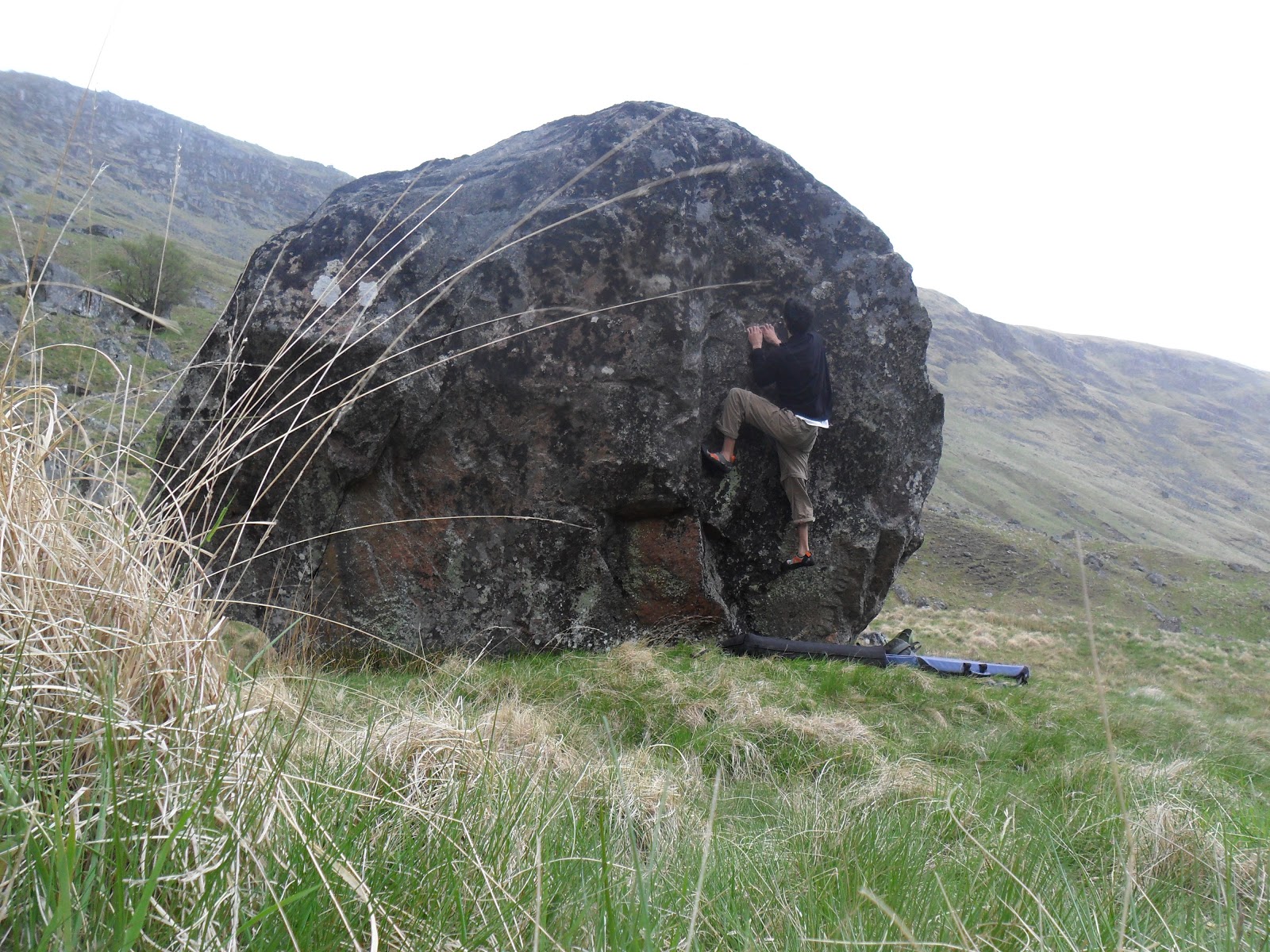
Bouldering at Agassiz rock, Agassize XL


Agassize XL

An undocumented L-R traverse that follows the line of least resistance of the entire crag.

Start at Rock-over (6a). 
Follow the High Traverse (aka Louie-Louie, 6b) until it runs out and move into the high groove (resting is cheating!).
Then follow a line of good crimps above the shield and settle on jugs. Make a long move to the crimps of Passing the prow (7a+, first crux). A technical sequence allows to drop onto a juggy shelf.
From the shelf, easier moves allow to step onto a big solid boss shield.
From the shield move around the corner and drop into an overhanging crimpy traverse (second crux) till you reach a big jug on the lip of the black slab. 
Match hands on the jug, rock on the slab and finish it up.

Grade is roughly f7b/+. 

Since it's roughly 70 moves, it's probably worth F8a-ish in sport climbing money but I don't do sport climbing so I wouldn't know :-)

Saturday, 14 March 2015

Bouldering at Salisbury Crags - Devo Max Traverse


Devo Max Traverse, 7a

Undocumented Line - Eliminate of 'Non-Juggy Traverse'

Traverse left to right as per 'Non-Juggy Traverse' to reach the sloping boss (no jugs allowed). 
Stay on slopers and move over the lip of the small roof till you match a bore hole rail (small crimp, crux). 
A knee bar allows to reach the higher part of the sloppy arete up (no jugs allowed on either side).
Finish standing above in a groove corner.

7a+ without the knee bar? ;-)


Thursday, 26 February 2015

Dumbarton, Scottish mecca of modern climbing, to undergo a town planning “charette”


A consultation will get under way in Dumbarton and will focus on the future of the rock and its surrounding waterfront.

BBC news reports that "Dumbarton Rock has a long history. It formed part of a volcano that was active 350 million years ago and in more recent times - the 1500s - Mary Queen of Scots stayed in the castle built on it"…

… and fails to mention that Dumby is also the home of Rhapsody, E11 7a, the world's hardest traditional rock climb (it has received only 4 clean ascents so far), and of over 20 bouldering problems in the 8 grade, including the world famous Sanction, 8b, Pressure, 8b or Gut Buster, 8b+, to name just a few.

Given there is only seven boulders at Dumbarton Rock, speaking of "concentration of hard climbing" would be a euphemism.

Yet, there wasn’t a single piece of climbing info in the BBC news article – I suspect they have not yet discovered that one can climb these rocks with their "bare hands".

Apparently local people, businesses, landowners and historians are being asked how best to promote Dumbarton Rock as a tourist destination.

While we can assume that Glasgow climbers qualify as "local people", what about the rest of the climbing community?

Unesco, help please! We’re talking world climbing heritage here!

Admittedly, tourism rarely is a threat for climbing, but what happens if they decide to make a nice landscaped promenade round the boulders?

There will be safety issues: some climbs might simply get forbidden (or worse, damaged!) to protect the passer-by.

I’m not sure if the architects, Anderson Bell Christie, know anything about climbing, but let’s hope that the design team and the town council are aware of Dumbarton’s value for us.

P.S. (27/02/15): here's today's and tomorrow's programmes (to register, visit West Dumbarton Charrette website


Friday 27 February, Dumbarton Burgh Hall - Open to the Public from 9.30pm - 3.00pm

  • Project team working on proposals and drawing up: 9.30am – 12.30pm* *NB There are no active public sessions during this time but the public and 
stakeholders can drop-in to view what is going on. 
  • Public and Stakeholder Drop-in Session: 1.30pm – 3.00pm 
The public and stakeholders can discuss and feed back on proposals to the project team and in one-to-one sessions if requested.


Saturday 28 February, Dumbarton Burgh Hall
 - Open to the Public from 10.30pm - 1.00pm 

  • Public Exhibition with Feedback / Questionnaire Sheets: 10.30am – 1.00pm 
The exhibition will display annotated plans, drawings and illustrations of proposals developed from the charrette event for comment. 
March 2015

Final Presentation and Feedback event, further details in due course.

Thursday, 22 January 2015

More bare hand activity...

With the freeing of Dawn Wall, the return of journalistic masturbation was inevitable:

“Of course, with just their bare hands to guide them, bloodied fingers and bruised, broken finger nails become the painful norm.”
(The Independant) 
“Three thousand feet of some of the hardest climbing in the world. And just their bare hands and sticky-soled shoes to get them up the granite-faced monster known as the Dawn Wall.”
(CNN) 
“Could every inch of the blank, vertical face of the Dawn Wall be climbed with nothing more than bare hands and rubber-soled shoes?”
(New York Times) 
Kevin Jorgeson attaches clamps to the sheer granite face of El Capitan with his bare hands during the epic climb.
(Daily Mail)

The list goes on... 

I leave you to it, I'm off to find something to keep my bare hands busy.


Come to think of it, wearing gloves might not be such a bad idea.

Tuesday, 6 January 2015

The Boulder: a philosophy for bouldering...

I was less than half way through Francis Sanzaro’s The Boulder - a philosophy for bouldering when it struck me. This is the best book I’ve read about bouldering so far (I haven’t read many mind you).

At last, here’s someone who sees bouldering as something more than just a sporting challenge, someone who looks at this art from various points of view, with all their complexity and contradictions.

Of course, the title can be misleading. This book is neither about bouldering tricks, nor about training – not from a purely practical point of view anyway, unless you consider that reflecting on what bouldering means to you should be one of your training goals.

Indeed, Sanzaro’s 'philosophy' for bouldering is not American (it does not propose a 'guiding principle' for your business activities...). His philosophy does what it says on the tin. His book intends to study the fundamental nature of bouldering. This will inevitably sound tedious to those who hate the buzz the brain produces when it works.

Personally, I like it. I’ve always been interested in how my body related to its environment, how it perceived space (void or conversely, materialised), how my brain analysed these perceptions and made use of it. I’ve always taken a great pleasure in touching, and anticipating the feel of a hold. When I see a piece of rock, my brain starts reading it and I imagine myself climbing it. And indeed, I take pleasure in visualizing the potential moves.

Most boulderers will intuitively understand the feelings and thoughts I’m talking about. But it is so difficult to put them into words, perhaps because we lack the time to do so, but more certainly because we think we do not have that time. You see, this is not serious matter. Society has taught us what is vital and bouldering isn’t part of it.

These are the kind of topics that Sanzaro touches but when I checked online to see if this great book had been reviewed or had had any success, I found very few references.

The first review Google pointed me to was an appalling rant by self-proclaimed “outdoor writer” John Appleby. I do not know if Appleby is a frustrated boulderer, but he seems to be a frustrated writer. I suspect Sanzaro succeeded somewhere he must have failed.

I think, however, that one condition should apply to both reviewing and good criticism: critics should like – or, better still, love – the medium they are reviewing. These are not my words by the way, but those of a famous editorial writer, William Zinsser who I shamefully plagiarize here (see On Writing Well, 1976/2006 for more).

If like Appleby, you “haven’t got a clue what this guy is on about” because “it was really passing over my head”, then move on! Don’t waste your time writing about it, write about something else you liked. Better still, if you think that “to succeed is to bring about a sense of achievement and satisfaction” then focus on what brings you that: get out and climb!

So new year's resolution folks (pretty please!), do with books what you do with boulder problems: Forget about those you didn't like and share those you enjoyed.

I'll start:

The Boulder - a philosophy for bouldering by Francis J. Sanzaro, Glasgow: Stone Country Press, 2013


PS: Interview of the author is available on Robinclose's blog.

Monday, 22 September 2014

Bouldering at Hummell rocks (II)

Hummell wall - Gullane beach (near Edinburgh)

I've climbed another few problems on the mini-cliff wall of Hummell Rocks, at Gullane beach, near Edinburgh (East Lothian).

Don't use any hard/wire brushes pretty please!


1. Prow, 4. Can be topped out but descent is harder than the ascent.

2. Prow eliminate, 6b. Any holds on  the left side of the round prow is out. Sit start at obvious twin side pulls and move up on crimps till the top.

3. Tangology, 7a. Sit start on two big flatties. Make an awkward step leftward to small edges. Settle using a vague thumb catch side sloper, before launching to juggy holds above. Finish more easily but high or jump off.


4. Rise of the caveman, 6a+. Eliminate - no bridging allowed on the right or left.  Sit-start at the mini-cave on good flatties. Rock onto a left foothold to reach a higher flat ledge. Reach high and leftward to a good wide edge. Finish at the line of jugs above.


4. High and dry, 6a. Easier for the tall. From the sandy hole or the small edge, launch up to reach a hidden jug. Move up and rightwards to good holds. Jump off or finish up (not recommended on your own).

Monday, 15 September 2014

Bouldering at Hummell rocks

Hummell wall - Gullane beach (near Edinburgh)


I've climbed a few problems on the mini-cliff wall passed Hummell rocks, at Gullane beach, near Edinburgh (East Lothian). The ones below are the least sandy, but you will still need a gentle brush to clean off the holds (especially after kids' sand battles).

Don't use any hard/wire brushes pretty please!


1. Crimpy arête, 6a. Stand start on a two fingers pocket hole and climb the vague arête on crimps. escape and descent leftward on the slab.

2. Hummeliation, 6b. Step up from the finger tips pockety crack at head height and slap to crimps. Then up and finish as previous.

2 bis. Humiliation, 7a. As previous but start hanging both hands on the finger tips pockety crack.

3. Slab and wall, 5+. Step onto the slab then traverse left onto the wall and finish as previous.


4. Mini-Roof, 6a+. SS under the mini-roof, rock over the lip and finish up as high as you wish. Nice problem with a perfect landing (no mat required!!!).

There's a small alley at the back of the wall, which looks nice. Unfortunately, all the lines are easy and the place gets interesting only once you start eliminating:


Monday, 18 August 2014

Bouldering at Agassiz rock - The Lock Reloaded

Agassiz rock, Blackford Hill, Edinburgh


A major hold of the crag, an undercutting finger pocket under the small roof of the overhang, is completely gone. A flat edge remains, which opens potential for new versions of the classic lines.

Here's one of my owns, The Lock Reloaded, a cool sit-start that includes a couple of dynamic slaps and a high (but easy) top out:

Thursday, 26 June 2014

Craiglockhart - Update

Bouldering near Edinburgh, Wester Craiglockhart Hill


1. The Pinch, 6c+ 


From any hold to the right of the 'Shark' arete, deadpoint (or dyno) to a white sloper below the top and finish on the sharp jaws of the 'Shark'. 

2. The Pinch SS, 7b. 


Eliminate. Sit start at a broken brown vertical rib to the right of 'Shark' (harder for the tall). Any good hold on the left side corner/arete is out. Pull on small edges to gain a LH sloper and RH square pinch hold - or any other small edge and finish as for the pinch.

3. Hung Parliament, 6a+


Sit start under the bulge. Pull hard on crimps and sloper to reach the only good jugs of the wall. A technical sequence leads to hidden holds at the high break. Finish traversing left and down on ‘Shark’.

4. Hung Parliament direct 6a


As previous but finish straight up at the break on good holds.

5. The niche, 6b. 


Sit start at good but sharp crimp, slot or undercut into the small niche and reach for the flat diagonal side pull/pinch. From there, traverse left and finish as for ‘Hung Parliament’.

6. The niche direct, P

Eliminate. Sit Start as previous but straight up on crimps to the high break of ‘Hung Parliament direct’. The LH jugs and RH scoopish sloper by the ivy are out.

Monday, 19 May 2014

Outdoor Bouldering near Edinburgh

Agassiz Rock and Salisbury Crags


Dynamic panoramic view of Agassiz Rock


According to Robert Craig, a self-proclaimed “native Scot with the inside knowledge that entails”, “the best-known bouldering area near Edinburgh is Aberdour”.

Craig goes as far as claiming that “Salisbury Crags aren't good quality climbing”.

Given the advice is available on a website called “Allexperts dot com”, one is tempted to take it for granted.

Dear Edinburgh visitor, who's joining the crowds of the "Homecoming Scotland 2014", don’t be fooled. Judging by his assessment of rock quality, that expert is probably a hill walker who thinks that bouldering is another way to reach the top of a mountain.


The best outdoor bouldering in Edinburgh is at Salisbury Crags and Agassiz Rock

Salisbury Crags - The South Quarry

Salisbury Crags are the best venue in Edinburgh in terms of both rock quality and setting.

And by its overhanging nature and its profusion of holds, Agassiz Rock, near Blackford quarry, provides the best naturel training venue for bouldering in Edinburgh.


But if you think that soloing 10 meters high HVS routes above spiky rocks  - or at best above very shallow waters – is the definition of good bouldering, then yes, Aberdour is probably a bouldering venue.

All experts indeed.


Saturday, 10 May 2014

Undeniably Glendo

Glendalough from the sky


The beauty of watching British TV crime series is that you get to see Wicklow, where they are actually shot.


Tuesday, 22 April 2014

Gairloch coast

Bouldering near Gairloch (Carn Dearg YH/Sands camping) and North Erradale, Ross & Cromarty, Highlands


1. Black wall, SS, 3
2. Tank Top, SS + traverse, 5
3. Sex air an traìgh, SS/dyno, 7a
4. Topless, SS/deadpoint from crimps, 6b
5. Am Buntàta reamhar, eliminate: double dyno (both hands) from SS, 6c


6. Font & low, SS, 6a
7. Font & low direct, SS, 6b
8. Project


Cave Area

Potential for highballs with bad landings or trad routes with good gear


9. Grug, SS from big sloper and deadpoint over the lip, 6a

10. The Croods' traverse, SS, 6b
11. Eep, SS to sloper traverse and mantelshelf and up, 5+
12. Guy, SS, wall and rock over mini-roof, 6a


13. Crack and flake wall, 5 (project from SS)


More bouldering/climbing potential around

Wednesday, 16 April 2014

Finisterre - O Granito galego


Bouldering in Galicia - Finisterre trailer (Mens segment)


I've said many things along those lines before but here it goes:

"Far-off from Europe’s mainstream bouldering hotspots lies one of the continent’s most overlooked climbing regions.

Galicia, in the northwest of Spain, has many things to offer. Spectacular boulder fields litter the storm-tossed coast and the undulating hinterlands.

But it’s the locals that make this lovely spot of land so special. People like Ben de Corme or Finuco Martinez, who contributed to establish one of the most interesting bouldering areas, sparkle with motivation and hospitality.

Follow the three Austrians, David, Niko and Stefan, on a journey to the world’s end, where they find out, what bouldering in Galicia is all about".


Saturday, 6 July 2013

Route or boulder traverse?

There's a thin line between a boulder problem and a route.


In 1995, when the hardest grade ever climbed was still 8c+, cheeky Fred Rouhling announced he had climbed a 9b line in Les Eaux claires. Called Akira, the line followed the roof of a cave and finished through a very steep section of overhang.


Most Americans dismissed the grade. At that time, the strongest of them were struggling on 5.14b - roughly 8c? European climbers were stronger anyway. That same year, Swiss climber Elie Chevieux sent the first 8b+ on-sight. But even the Europeans weren't too inclined to believe Rouhling. 

French man Jibé Tribout, who was competing with Ben Spoon and Gerry the Muppet for the unofficial title of world's top climber, was no particular friend of Rouhling. But he went on to try Akira. He said he found it to be a very dangerous line because "you hang at three or four meters off the ground and with some of the moves, you take the risk to land flat on your back". He thought it was a quick step from 8c+ to 9b, but reckoned that Akira was nevertheless much harder than anything that had been climbed before (read his interview in On the Edge n°102 if you can find it).

There was also an excellent article by Pete Ward and Tim Kemple in Climbing Magazine, featuring a discussion with Alexander Huber where he questions Rouhling's track record : 

Huber gestures with his hand: “If Rouhling’s level is here,” he says, holding his hand at chest level, “and then with Akira it is here” — he holds his hand at his forehead — “then there should be many other routes around here.” The hand is level with his nose. “Where is this track record?” Huber asks. The hand moves to the side of his head, palm up. “Why hasn’t he done many other hard routes soon after Akira?”
 Tim leans into the table and says, “Because he couldn’t climb for almost two years.”
 “Why is this?” Huber asks.
 “Because he had two kids, and his wife had brain surgery and almost died.”

Well since then, Rouhling has actually repeated a few other routes, including Fred Nicole's Bain de sang, 9a, though Dave Graham, who has also climbed it, thought it was easier than Wolfang Güllich's Action Directe (first established 9a). But Akira, on the other hand, hasn't been repeated ; neither by Huber, nor by anyone else.


What if Akira was a boulder problem?


What's interesting in all that debate is that everyone defines Akira as a route. But on the Youtube video, Rouhling uses no rope, no harness, no quickdraw. What if it was a boulder problem? 

Its 9b grade would correspond more or less to an 8c+ in bouldering money. What else is available at that grade? Tonino 78 (Meschia, Italy, 15 moves, FA Mauro Calibani 2004), The Wheel of Life (Grampians, Australia, 60 moves, FA Koyamada 2004), Terremer (Hueco Tanks, USA, 11 moves, FA Fred Nicole 2006)? 

The 60 moves of The Wheel of Life are actually considered to be a boulder line (the original grade being V16). What would make it harder than Akira then?

Monday, 24 June 2013

Do you feel the pain?

How many times have I come back in bits after a long session outdoor? Why is it that my body aches so much after just a few problems? More interestingly, why does it ache so much more than it would after a similar - or more intense - indoor session?
I’ve often wondered and attributed this pain to the consequences of various factors: 

1. Conditions


It’s cold outside. Colder than inside. So my muscles contract more, hence more pain the next day. That and Her Ladyship, Ms Dampness. The humidity factor definitely has an impact on the repeated intensity when working on a problem. Don't you know the famous Irish saying "it's getting dampish, pull harder!" 

2. Focus 

I tend to push myself more when outside because I really want to send those (un)established problems while I don’t really care about indoor pink resin problems that will eventually be stripped from the climbing wall. Furthermore, I’m not distracted when outside because there’s no music on, no other people to watch, no clock on the wall, no signs of human presence - or so much less. 

3. Shock absorption 

I don’t notice it but I hurt myself when outside. I keep knocking my elbows and my knees. I have a mat but it’s very small compared to the big blue bed laying at the bottom of an indoor climbing wall - why is it they are always blue? - which means that in the end, added together, all these little outdoor jumps represent a bigger resistance force applied to my body structure than that of those indoor jumps, because less shock absorption is taking place.

But it actually hit me. It’s not that, it’s the rock itself. 

When I pull on resin, the overall elasticity of the body+climbing wall system is bigger than that of the body+rock system, because there is a lot of elasticity taking place in the connections between the resin hold, the screw, the wall timber panel and the wall structure.

Whereas the rock, well, it’s not known for being particularly elastic (apart from that flake at the start of Superswinger, but that’s an exception really).

(I thought I could sketch these properly in 3D on computer but I prefer to use my spare time for climbing sessions these days)
So, in the case of rock-climbing, as opposed to resin-climbing, more of the elastic absorption is done by my muscles and my skeleton. Hence the pain.
It's kind of obvious now that I think about it and I’m sure this must have been studied somewhere by someone but my climbing readings are scarce at the moment. 
So anyone feeling the pain? 

Monday, 3 June 2013

JuanJorge

Bouldering at JuanJorge, Glen Clova/Glen Doll (South Esk river), Angus


Existing undocumented problem, +/- 6a


Existing undocumented problem, +/- 5


 Existing undocumented problem, +/- 5 


Existing undocumented problem, +/- 6a


Projects above a very boggy landing (who's up for a bit of cleaning?)

Friday, 19 April 2013

Sand Bay, Ross & Cromarty

Bouldering at Sand Bay, Applecross, Ross & Cromarty

Spent Easter weekend in Ross and Cromarty. Added two cool problems to Sand Bay's MOD boulder.


Neolithic Orangeman direct, 6c, sit start


Red Cuillin, 6b, sit start (this one actually tops out)


View Larger Map

Wednesday, 28 November 2012

Bare hand climbing (AKA the real thing)


The editorial director of Le Monde diplomatique, recently lamented the threat that cheap news represent for serious journalism. Truth is, serious journalism is a rare thing these days. With the death of French climber Patrick Edlinger, cheap news titles were inevitable. You know what I’m talking about - “bare hand” climbing (escalade “à mains nues”).

Guess what? They all fell for it:

Le Monde “Patrick Edlinger, pionnier de l'escalade à mains nues” ( 23/11/2012)

Libération “Patrick Edlinger, mains nues ciao” (18/11/2012)

L’express “Patrick Edlinger, qui avait effectué à mains nues et parfois même sans être assuré...” (17/11/2012)

L’humanité “On l'y voyait vivre totalement sa passion, l'escalade, évoluer dans les gorges du Verdon sans corde, à mains nues, en solo intégral.” (17/11/12)

La Croix “Patrick Edlinger, pionnier de l’escalade à mains nues, est mort” (17/11/12)

We all remember La Vie au bout des doigts (if you’re my age or over that is...), a documentary by Jean-Paul Janssen, featuring Edlinger when he was not yet a legend. This film changed him into a real star in France (forget climbing gear sponsors, French biscuits LU made millions using his charisma). More importantly, climbing reached a wider audience thanks to Edlinger.

It’s almost thirty years since La vie au bout des doigts was released ; thirty years since Edlinger became a legend ; thirty years since climbers started to seriously promote climbing for all. For thirty years France has seen climbing walls flourishing in city parks, schools, and even at nurseries... Climbing walls for all! Nowadays, even the French leaving cert candidates may choose climbing as sports exam - yes, we do have a sports exam for the leaving cert, the so called “education physique et sportive”.

In 1985, surfing the Edlinger wave, French climbers founded the French Climbing Fédération, who merged with the French Mountaineering Fédération a few years later, to become the FFME, a organisation who participated in the birth of the climbing World Cup and who’s now campaigning for the integration of climbing in the Olympics.

And yet, thirty years later, journalists keep talking about climbing “with bare hands”. It makes you wonder if they do any investigation on the topic before writing their papers.

How about gymnastics, or swimming with "bare hands" ?

PS: We'll miss you sorely Mr. Edlinger.


Tuesday, 18 September 2012

A Perla negra (II) - Tirán (Neno do Curvo, Moaña)

Bouldering at Tirán beach (Neno do Curvo, Moaña/Cangas), O Morrazo, Pontevedra, Galicia

"O que se pode ver en Neno do Curvo son rocas de dous tipos: unhas de natureza aceda e cor clara (as granodioritas e granitos) e outras de natureza básica e cor verde escura, ás veces case negro (gabros, cuarzodioritas e tonalitas)."

(La Voz de Galicia, 22/05/2007)


  1. 5, arista, sentado
  2. Groovy, 4, sentado
  3. 4, sentado
  4. Barrera extension, 6a, sentado, travesia hacia la izquierda, salir en Groovy.
  5. Barrera directa, 6b, entrada sentado, salida directa.
  6. A Perla negra***, sentado, 6c (saida dereita) / 7a (directa)
  7. 6b, mantel, sentado
  8. Abordaxe, 6c, sentado
  9. 5+, de pies
  10. A proa da Perla negra, 5 de pies, 7b, entrada sentado


Sunday, 16 September 2012

A Perla negra - Tirán (Neno do Curvo, Moaña)

Bouldering at Tirán beach (Neno do Curvo, Moaña/Cangas), O Morrazo, Pontevedra, Galicia


 La popa de la Perla negra, 7a, SS (sentado)


La proa de la Perla negra, 7b, SS (sentado)