Saturday, 10 May 2014
Tuesday, 22 April 2014
Gairloch coast
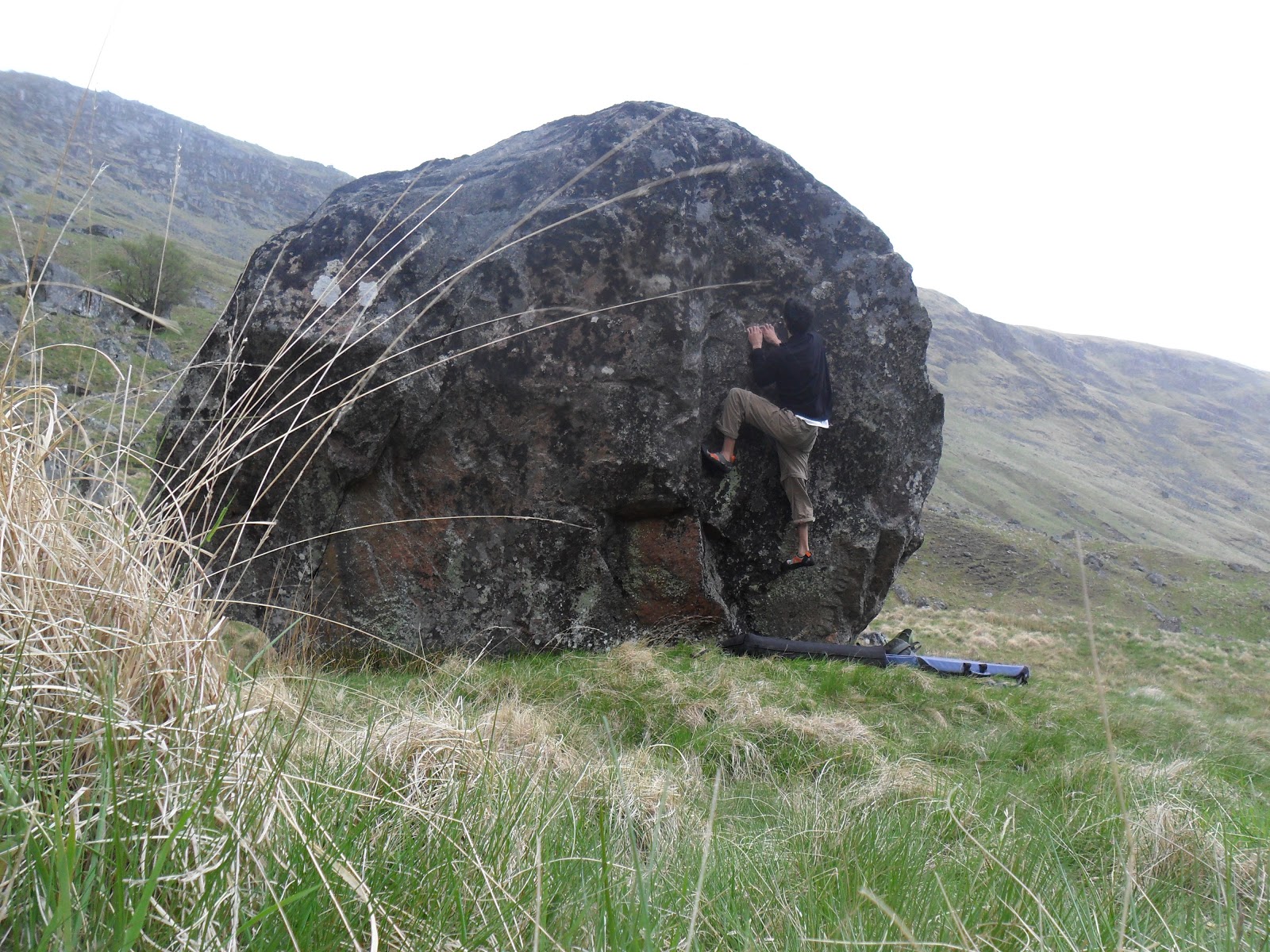
Bouldering near Gairloch (Carn Dearg YH/Sands camping) and North Erradale, Ross & Cromarty, Highlands
1. Black wall, SS, 3
2. Tank Top, SS + traverse, 5
3. Sex air an traìgh, SS/dyno, 7a
4. Topless, SS/deadpoint from crimps, 6b
5. Am Buntàta reamhar, eliminate: double dyno (both hands) from SS, 6c
6. Font & low, SS, 6a
7. Font & low direct, SS, 6b
8. Project
Cave Area
![]() |
| Potential for highballs with bad landings or trad routes with good gear |
9. Grug, SS from big sloper and deadpoint over the lip, 6a
10. The Croods' traverse, SS, 6b
11. Eep, SS to sloper traverse and mantelshelf and up, 5+
12. Guy, SS, wall and rock over mini-roof, 6a
Wednesday, 16 April 2014
Finisterre - O Granito galego
Bouldering in Galicia - Finisterre trailer (Mens segment)
I've said many things along those lines before but here it goes:
"Far-off from Europe’s mainstream bouldering hotspots lies one of the continent’s most overlooked climbing regions.
Galicia, in the northwest of Spain, has many things to offer. Spectacular boulder fields litter the storm-tossed coast and the undulating hinterlands.
But it’s the locals that make this lovely spot of land so special. People like Ben de Corme or Finuco Martinez, who contributed to establish one of the most interesting bouldering areas, sparkle with motivation and hospitality.
Follow the three Austrians, David, Niko and Stefan, on a journey to the world’s end, where they find out, what bouldering in Galicia is all about".
Saturday, 6 July 2013
Route or boulder traverse?
There's a thin line between a boulder problem and a route.
In 1995, when the hardest grade ever climbed was still 8c+, cheeky Fred Rouhling announced he had climbed a 9b line in Les Eaux claires. Called Akira, the line followed the roof of a cave and finished through a very steep section of overhang.
Most Americans dismissed the grade. At that time, the strongest of them were struggling on 5.14b - roughly 8c? European climbers were stronger anyway. That same year, Swiss climber Elie Chevieux sent the first 8b+ on-sight. But even the Europeans weren't too inclined to believe Rouhling.
French man Jibé Tribout, who was competing with Ben Spoon and Gerry the Muppet for the unofficial title of world's top climber, was no particular friend of Rouhling. But he went on to try Akira. He said he found it to be a very dangerous line because "you hang at three or four meters off the ground and with some of the moves, you take the risk to land flat on your back". He thought it was a quick step from 8c+ to 9b, but reckoned that Akira was nevertheless much harder than anything that had been climbed before (read his interview in On the Edge n°102 if you can find it).
There was also an excellent article by Pete Ward and Tim Kemple in Climbing Magazine, featuring a discussion with Alexander Huber where he questions Rouhling's track record :
Huber gestures with his hand: “If Rouhling’s level is here,” he says, holding his hand at chest level, “and then with Akira it is here” — he holds his hand at his forehead — “then there should be many other routes around here.” The hand is level with his nose. “Where is this track record?” Huber asks. The hand moves to the side of his head, palm up. “Why hasn’t he done many other hard routes soon after Akira?”
Tim leans into the table and says, “Because he couldn’t climb for almost two years.”
“Why is this?” Huber asks.
“Because he had two kids, and his wife had brain surgery and almost died.”
Well since then, Rouhling has actually repeated a few other routes, including Fred Nicole's Bain de sang, 9a, though Dave Graham, who has also climbed it, thought it was easier than Wolfang Güllich's Action Directe (first established 9a). But Akira, on the other hand, hasn't been repeated ; neither by Huber, nor by anyone else.
What if Akira was a boulder problem?
What's interesting in all that debate is that everyone defines Akira as a route. But on the Youtube video, Rouhling uses no rope, no harness, no quickdraw. What if it was a boulder problem?
Its 9b grade would correspond more or less to an 8c+ in bouldering money. What else is available at that grade? Tonino 78 (Meschia, Italy, 15 moves, FA Mauro Calibani 2004), The Wheel of Life (Grampians, Australia, 60 moves, FA Koyamada 2004), Terremer (Hueco Tanks, USA, 11 moves, FA Fred Nicole 2006)?
The 60 moves of The Wheel of Life are actually considered to be a boulder line (the original grade being V16). What would make it harder than Akira then?
Monday, 24 June 2013
Do you feel the pain?
How many times have I come back in bits after a
long session outdoor? Why is it that my body aches so much after just a few
problems? More interestingly, why does it ache so much more than it would
after a similar - or more intense - indoor session?
1. Conditions

I’ve often wondered and attributed this pain to
the consequences of various factors:
1. Conditions
It’s cold outside. Colder than inside. So my
muscles contract more, hence more pain the next day. That and Her Ladyship, Ms Dampness. The humidity factor definitely has
an impact on the repeated intensity when working on a problem. Don't you know the famous Irish saying "it's getting dampish,
pull harder!"
2. Focus
I tend to push myself more when outside
because I really want to send those (un)established problems while I don’t
really care about indoor pink resin problems that will eventually be stripped
from the climbing wall. Furthermore, I’m not distracted when outside because
there’s no music on, no other people to watch, no clock on the wall, no signs
of human presence - or so much less.
3. Shock absorption
I don’t notice it but I
hurt myself when outside. I keep knocking my elbows and my knees. I have a mat
but it’s very small compared to the big blue bed laying at the bottom of an
indoor climbing wall - why is it they are always blue? - which means that in the
end, added together, all these little outdoor jumps represent a bigger resistance
force applied to my body structure than that of those indoor jumps, because less shock
absorption is taking place.
But it actually hit me. It’s not that, it’s the rock itself.
When I pull on resin, the overall elasticity of
the body+climbing wall system is bigger than that of the body+rock system, because
there is a lot of elasticity taking place in the connections between the resin
hold, the screw, the wall timber panel and the wall structure.
Whereas the rock, well, it’s not known for
being particularly elastic (apart from that flake at the start of Superswinger,
but that’s an exception really).

(I thought I could sketch these properly in 3D on computer but I prefer to use my spare time for climbing sessions these days)
So, in the case of rock-climbing, as opposed to
resin-climbing, more of the elastic absorption is done by my muscles and my
skeleton. Hence the pain.
It's kind of obvious now that I think about it and I’m sure this must have been studied somewhere
by someone but my climbing readings are
scarce at the moment.
So anyone feeling the pain?
Monday, 3 June 2013
Friday, 19 April 2013
Sand Bay, Ross & Cromarty
Bouldering at Sand Bay, Applecross, Ross & Cromarty
Spent Easter weekend in Ross and Cromarty. Added two cool problems to Sand Bay's MOD boulder.
Neolithic Orangeman direct, 6c, sit start
Wednesday, 28 November 2012
Bare hand climbing (AKA the real thing)
The editorial director of Le Monde diplomatique, recently lamented the threat that cheap news represent for serious journalism. Truth is, serious journalism is a rare thing these days. With the death of French climber Patrick Edlinger, cheap news titles were inevitable. You know what I’m talking about - “bare hand” climbing (escalade “à mains nues”).
Guess what? They
all fell for it:
Libération “Patrick Edlinger, mains nues ciao” (18/11/2012)
L’express “Patrick Edlinger, qui avait effectué à mains nues et parfois même sans être assuré...” (17/11/2012)
L’humanité “On l'y voyait vivre totalement sa passion, l'escalade, évoluer dans les gorges du Verdon sans corde, à mains nues, en solo intégral.” (17/11/12)
La Croix “Patrick Edlinger, pionnier de l’escalade à mains nues, est mort” (17/11/12)
We all remember La Vie au bout des doigts
(if you’re my age or over that is...), a documentary by Jean-Paul Janssen, featuring
Edlinger when he was not yet a legend. This film changed him into a real star in
France (forget climbing gear sponsors, French biscuits LU made millions using
his charisma). More importantly, climbing reached a wider audience thanks
to Edlinger.
It’s almost thirty
years since La vie au bout des doigts
was released ; thirty years since Edlinger became a legend ; thirty years since
climbers started to seriously promote climbing for all. For thirty years France
has seen climbing walls flourishing in city parks, schools, and even at
nurseries... Climbing walls for all! Nowadays, even the French leaving cert
candidates may choose climbing as sports exam - yes, we do have a sports exam
for the leaving cert, the so called “education physique et sportive”.
In 1985, surfing the
Edlinger wave, French climbers founded the French Climbing Fédération, who merged
with the French Mountaineering Fédération a few years later, to become the
FFME, a organisation who participated in the birth of the climbing World Cup and
who’s now campaigning for the integration of climbing in the Olympics.
And yet, thirty years
later, journalists keep talking about climbing “with bare hands”. It makes you
wonder if they do any investigation on the topic before writing their papers.
How about gymnastics,
or swimming with "bare hands" ?
PS: We'll miss you
sorely Mr. Edlinger.
Tuesday, 18 September 2012
A Perla negra (II) - Tirán (Neno do Curvo, Moaña)
Bouldering at Tirán beach (Neno do Curvo, Moaña/Cangas), O Morrazo, Pontevedra, Galicia
"O que se pode ver en Neno do Curvo son rocas de dous tipos: unhas de natureza aceda e cor clara (as granodioritas e granitos) e outras de natureza básica e cor verde escura, ás veces case negro (gabros, cuarzodioritas e tonalitas)."
(La Voz de Galicia, 22/05/2007)

- 5, arista, sentado
- Groovy, 4, sentado
- 4, sentado
- Barrera extension, 6a, sentado, travesia hacia la izquierda, salir en Groovy.
- Barrera directa, 6b, entrada sentado, salida directa.
- A Perla negra***, sentado, 6c (saida dereita) / 7a (directa)
- 6b, mantel, sentado
- Abordaxe, 6c, sentado
- 5+, de pies
- A proa da Perla negra, 5 de pies, 7b, entrada sentado
Sunday, 16 September 2012
A Perla negra - Tirán (Neno do Curvo, Moaña)
Bouldering at Tirán beach (Neno do Curvo, Moaña/Cangas), O Morrazo, Pontevedra, Galicia
La popa de la Perla negra, 7a, SS (sentado)
La proa de la Perla negra, 7b, SS (sentado)
Subscribe to:
Posts (Atom)