10 July 2009

Moulzie outcrops


Further to the last post about Glen Doll, I have been searching the maps to find out where I had been climbing and it turns out that it was not Glen Doll but the valley of the river South Esk. Some grassy fords surround a farm estate called “Moulzie”, located right in the middle of the glen. After a second reading of the Stone country guide, I realised that John Watson is actually mentioning some granite stones near the Moulzie farm. I saw some boulders indeed but most of them were quite small and the mini-crag was far more interesting. On the other hand I did not walk as far as “Juan Jorge” crag which is located around the corner of “The Strone” and I suspect this is where the other large boulders he mentions are located.

23 June 2009

Glen Doll

After a highly interesting CPD about style in translations in Perth on Saturday I enjoyed the great outdoor on a sunny Sunday, something that had not happened in weeks.

My original plan was to go bouldering in Glen Clova, but granite is not exactly the most enjoyable type of rock when the sun is baking. Instead I decided to go and explore Glen Doll. Although I did follow the guidebook directions, I did not have a proper OS map and I am not sure if I found the right place. I did find a nice little outcrop in the shades though - little from a route point of view because some of the problems I did were easily over 5m/15ft height.


I first had a couple of unmotivated lazy tries at an awesome roof prow. Looking easy enough, with very solid holds, it has a good grass landing platform. My excuse for not committing is that I had no spotters and only one mat. Moreover, I promised my wife not do highballs on my own again.


My attention then turned to the slightly overhanging wall to left, which seemed to have two nice break lines, probably as high as the roof but easier looking – so I thought anyway. After a bit of warm-up and the inspection of the top out via an easy descent to the right, I tried the main break line in the middle of the wall. I don’t think it was harder than Font 6a but with the height it felt much harder. I used a mixture of some shaky footwork and excitement self-control technique, if such a thing exists.


I guess that was my promise broken, and since it was broken there was no point stopping there, so up I went on the second line. This one might have been easier, had I not decided to swap feet at the wrong moment. The next second I hit the ground hard and felt some pain at my wrist: nothing was broken but a seriously bleeding cut chilled my excitement for more highball.


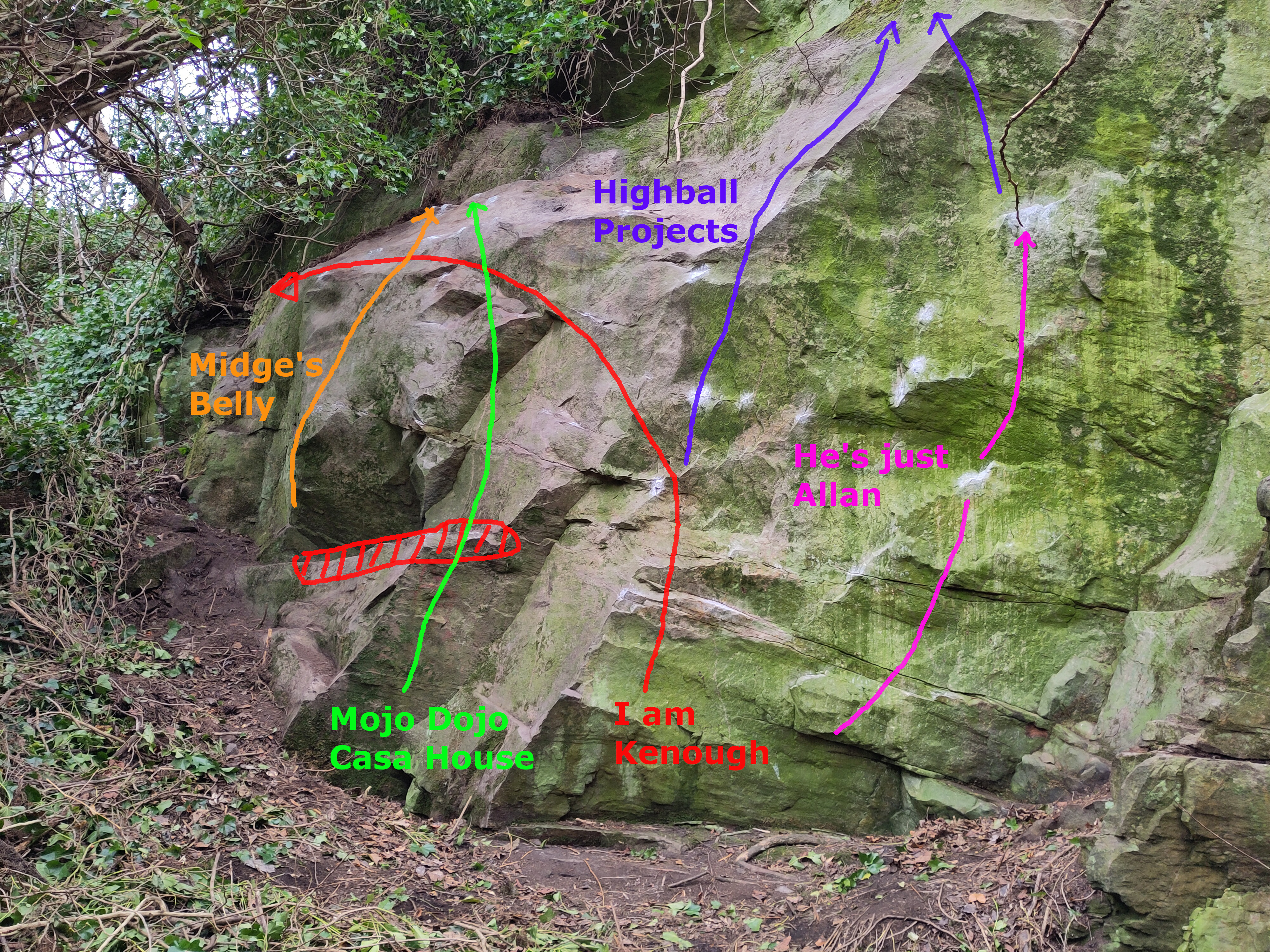
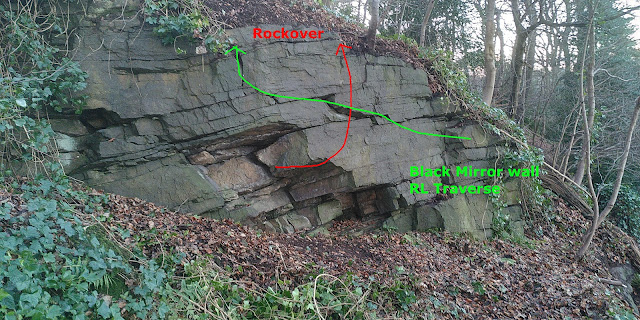
It was time to move on a less dangerous game. I climbed two other problems further left, as shown on the picture. It is worth mentioning there is a possible sit-start to the second line but it must go at a very high grade given the size of the crimps....


Finally I must confirm, as I was pointed out by my kind hosts that very same day, that there were no midges although it was June, it was very warm and there was no wind. So here’s a tip for the summer: stay East!


29 May 2009

Tim's visit

Nothing much happened since Tim Chapman was over. Did I mention Tim was over? No?

We had a couple of nice days in the Trossachs, in Loch Kathrine first (where I did not even give a go at the Barrel boulder) and in Ben Ledi the next day: it is quite a long walk with an unappealing finish but really worth it when you consider the size of the boulders. They are enormously mahussive! Not little stones with a couple of moves including sit-start but proper boulders which some would consider as highballs. The rock however is a sharp schist covered with little curvy waves and shapes.


Although this can be enjoyable for the photographer, it makes it hard to read for the climber: we got our bum well kicked, struggling up 6bs, throwing ourselves at fake jugs and missing hidden crimps...


Two days later I nearly flashed Mugsy traverse in Dumby which was good for my wounded ego.

Since then nothing.


Well that’s not true. Last week young Felix managed to get me on a rope at the Ratho wall, and dare I say it, I got scared on an overhang, maybe 25m high, with quickdraws every metre and full of big red resin blobs everywhere (apparently they call them holds...).
The reality is I am actually very busy at the moment as I am seriously considering starting a business as a freelance translator (Any publisher out there, hint! Hint!) and our little boy is seeking more and more attention, so this does not leave much time for climbing. Although on the long term this should mean much more time flexibility, it looks like I will have to get extremely organised if I do not want my climbing routine to suffer.

10 May 2009

Getting out

Having a baby is a great new life, but obviously it does have a serious effect on your climbing. You are more tired which means you need more rest and less training. The good side however is that you need to get out and the baby too, so instead of going to the park like most people do, I’ve decided I’d go to for long walks and check out a few places.

Benarty Hill

Benarty Hill is the obvious pointy hill with a crag at the top to the right of the M90 when coming from the Forth road bridge. I believe there is a nice walk to the top of the hill from Vane Farm Nature Centre, but that was not what I was interested in. From the road I could clearly distinguish a little boulder field at the bottom of the hill. The place is called Brackley and it is farming land but the boulders clearly lied beyond the boundary walls. (Not sure it is not included in the Vane Farm land though...)

So I walked up to them from the car park of the Nature Centre, just to discover that most of the stones are less than 2m high (which is probably why they are not documented anywhere...) The rock seems to be fairly solid though it was well weathered and would need some serious brushing.

I then walked up straight up to the crag to enjoy the nice sunset view over Loch Leven. The crag is not really high and has some awesome arêtes that would provide top class bouldering if they were not at the top of a 100m straight slope with virtually not proper landing platform... Here I must mention I have not any Scottish trad-climbing topo and maybe they are some routes up there, but if they are none then a couple of first ascents could be worth it as the location is purely stunning! And it’s only 30mn a drive from Edinburgh with another 30mn approach walk, depending on your fitness that is...

Loch Katrine

The whole family (that would be just the three of us, but I quite like the sound of it...) went to Loch Katrine for a Sunny Sunday afternoon. The ferns had not grown yet and it was a very warm day. The place is beautiful enough to enjoy as picnic location but hey, why would you go there without a pad and a pair of climbing shoes?


After a good warm up on the Sentinel boulders, I had a few of hopeless goes at Lock, stuck and The Victorian. I gave up probably too fast (John, if you’re reading this: are the upper crimps in?) and tried a full traverse of the Barrel boulder from the left, but could not finish it. I then got stuck into Big up, but after what seemed like a 100 tries I finally packed up and enjoyed the rest of the day trying to show the beauty of the Trossachs to my wee bairn as they call them over here. Pretty much a good day I thought!


Earlsferry

Having climbed all the sandy lines in Kirkcaldy and given the fact that there are not too many eliminates there, I thought I could go and look further north along the coast. This is how I came across that little roof about which I posted a video last week.

We went for an afternoon picnic in Earlsferry and the tide was out, uncovering that nice “canyon” alley with the mine-entrance-look-like roof at the end. It is located here, approximately a 100 m from the road, so it's good for a quick evening summer session if you happen to be around. The rock is columnar basalt and is really solid. I got three lines out of it as shown on the video:

1. Left side SS. Stand up using a slot crimps, wee undercuts and the big hole, move out and top out.

2. Right Side, SS off the huge undercut jug, feet on the big ledge, move to the small middle crimpy rail and slap to the lip of the roof. Top out.

3. SS on the back undercut jug, lock the right foot and reach back to good crimp. Use a pull-toe and move to the small middle crimpy rail. Slap to the lip of the roof and top out.

Unfortunately this is the only thing there is in Earlsferry. However, we could see the appealing cliffs of Macduff cave in the background and even though I suspect the rock is probably very loose there, I will give it a go as I heard the chain walk was a nice Sunday afternoon promenade.

Agassiz Rock

We also went a few times to Agassiz Rock though it is getting quite boring: I tend to boulder only on the left part of the wall now since that overhang seems to be much looser than it looks.

Since I started to go there in January, many holds have disappeared, the main ones being the top jug referenced D/E-4/5 on http://www.scottishclimbs.com/ (That wasn’t me!) and the bottom Sit-Start jug referenced H13 (Ok, that was me...). One time I met a few lads who were pulling hard on the groove crack: I said that the whole thing was going to come off. That was a joke, but if it does happen, at least they’ve been warned....

04 May 2009

The Mine

Last weekend I came accross this little roof:


video

It's a pity there is nothing else around because the rock is really good. I still managed to get 3 problems out of it. Not so bad given that the original plan was to go for a walk...

05 April 2009

Sun, snow, sun, snow, sun, snow, sun, snow...

I bought John Watson’s guide last year, and since I first opened it, I have been dying to visit Torridon. Unfortunately every time I planned to go, something went wrong. This time it was supposed to be the weather.

That was without taking into account the dedication of the stubborn boulderer that we can sometimes be. A week ago, Felix and I had planned to leave on Friday and be back on Saturday night, even though the forecast was not great: -3 degrees feeling like -18 in the wind above 700m, bands of snow coming from the north-west, freezing above 300 meters... Don’t check the Scotland mountain weather forecast, it really puts you off.

We left at 2 o’clock and arrived around 7ish. Considering we stopped in an Agatha Christy style empty hotel (Murder in the Highlands) for a burger that was as tough as leather (the murder weapon, served by a cross-eyed waiter), I considered this being a reasonable journey. However it was too late to go bouldering so we waited until the next morning.

We woke up under 3 inches of snow, and it did not seem to be getting any better. So after having checked that magnificent but wet Ship boulder, we decided we would visit the other bouldering spots around and come back in the afternoon if the weather had improved.


Kishorn boulders

Kishorn was the only spot we visited that morning. By the time we were at the boulders, the sun was shining and the boulders were extra dry, which gave us our first taste of that awesome torridonian sandstone.

Although the place is well described in the guide, we managed to miss the first boulder (Russell Boulder) and started the session on the Kishorn boulder of which the south face provided good shelter, dry landing and a hard project that is not indicated in the guide: just right of Kishorn Dyno is a little wall with a few fainted but brushed clean holds. I must say it looks more doable that it actually is and I reckon it must be harder than 7b.

The weather rapidly changed again and within seconds the sky was dark grey and it was snowing. But it lasted just a few minutes and only then we realised that these were cracking conditions as the rock stayed cool and dry thanks to the cold wind and bands of snow, while we could enjoy the real warm sun in between.

Before going back to Torridon, we spent a bit more time in Kishorn, Felix more specifically on the South wall of the Swamp boulder and I on eliminating the foot jam and the juggy arête of the Cave (I guess that makes it a completely different problem then....)

The best boulder problem in Scotland?

When we came back to Torridon, the Ship boulder was a bit like in the picture of the guidebook: big, reddish, very dry and Richie Betts was on a mission. Actually it was not the Mission, but Malcolm’s arête the very one line I was psyched for.

Richie and his mate Murdo seemed well equipped for the place. At first sight I knew these were not casual boulderers as both lads had come in their wellies. Moreover they had placed a huge tarpaulin over the pond -yes, we are talking DWS here. This and a wood pallet strategically placed offered a perfect landing area when combined with a couple of pads. Clearly they had to be “locals”.

Still they seemed a bit surprised when they saw us coming and they probably thought we were a bit stupid -though clearly lucky- to have chanced that unsettled weather for a one day trip only. But they had no problem sharing their landing platform and after a few tries I finally got my reward: would it sound slutty to say that it was better than I had imagined?


I don't know if it was because of the extremely good conditions, because of the pond below or because of the broken hold, but one thing is for sure, it was a bit different from what I had expected and I think that the picture in John's guide is actually misleading so I decided to do a bit of editing:


As Carrie Bradshaw usually puts it, I couldn’t help but wonder: what if Malcolm’s Arête was the best boulder problem in Scotland? (Yes, I’ve watched it several times, my wife wouldn’t let go the remote control, what’s your excuse?) As a matter of fact, I asked the lads if this was indeed the best boulder in Scotland but they eluded the question. So I decided to apply my 7 criteria and see how high it would rank:


Rock quality: Top quality sandstone with some pebble inclusions, behaving a bit like grit. 5/5

Approach: Although it is very close to the road, the place is a bog, so bring on the wellies. 4/5

Conditions: Ok, this one is very debatable. This is the highlands, so the weather is unpredictable. But that rock seems to dry fast and the big puddle at the bottom was actually constituting a great landing area once Richie had covered it with a tarpaulin. 3/5


Line Clarity: No discussion possible here. 5/5

Moves: Classic moves including both campusing and footwork, dyno and mantelshelf. The essence of bouldering... 5/5

Location: Well, just pick up any tourist information about the highlands, and you’ll know what I’m talking about... 5/5

Popularity: I may not be familiar enough with the Scottish bouldering scene to be able to judge, but the fact that we actually joined other people trying the line would lead me to think it is indeed a popular boulder. I also understand that the FA was sent by some dude called Malcolm Smith. Enough said. 5/5.

That’s a score of 32 out of 35, certainly a strong contender for the title of Best boulder problem in Scotland!

Most pictures are courtesy of Felix Davey.


"Dude check that boulder over there: it looks ace!"

01 April 2009

Bouldering guide to Ireland 2009 version 4.0

The Short Span Bouldering guide to Ireland 2009 - version 4.0 is here!

It has been less than a year since the last update and over another 400 lines have been added.

Dave Flanagan says: "This guide is intended to be reasonably definitive but just because something has been climbed doesn't mean it is worth documenting so I haven't detailed every variation, eliminate, lowball sit-start or squeezed-in micro line. "

So it looks like the Irish bouldering has never been so vibrant!

More info on Dave's website.


26 March 2009

Short Slam and grand Span miss

They say time is flying when you’re having fun and it has been a good month since I last looked at that blog. What happened since the last post?

  1. The unemployment rate has exploding in both Ireland and Scotland.
  2. Unlike the Scots, the green people had a good occasion to rejoice after their national team won their first grand slam in the 6 nations (yes they did it in 1948 too, but it was merely a triple crown since there was no Italian team and the French team was as good with an oval ball as the Ethiopians are with a curling stone).
  3. The 7th Irish bouldering meet was held in Glendalough. Unlike the previous two years, the lads seem to have enjoyed some gorgeous conditions.
  4. I missed the last two events because my wife was stuck in Hospital, giving birth to our first child, a baby boy that is already more Irish that I will ever be...


However I managed to get some climbing done since the beginning of February.


First of all, my brother came to visit us back in February and we went to check all the bouldering spots that stand within a couple of hours drive from Edinburgh. My original plan was to go to Torridon but the baby could decide to pop out anytime and our moves were reduced to short day trips. And by the way, that meant no drinking either. I guess I’ll become a really healthy boulderer. On the positive side, the weather was nearly perfect all week long and we had a good session nearly every day.

The highlight of them was Glen Clova, a glendaloughesquish valley about 2 hours drive from Edinburgh. We also went to Glen Lednock, Kilcardy and the crappy Wolfcrag, but these were definitely not as good, though Lednock deserves a couple of stars for its location. Being in Glen Clova felt like being back home (err... I mean back in Ireland). Although it is a bit of a drive, the place is really worth it. Like Glendo, I suspect the place was primly a trad-climbing venue as there seem to be some good walls around, but for the boulderer, the good stuff is the grey granite boulder scree full of silly sheep at the end of the long valley. Although it is accessed by car, it is quite remote and there was very little traffic.


Like in Glendo the problems are quite short with a lot of sloppy arêtes and crimpy walls. The landings can be dodgy but with a couple of pads and a spotter, you are usually fine. The main boulders have been developed but there is plenty more for exploration. We actually first spotted an overhanging boulder that was distinctively standing on top of another one. We climbed two problems on it including a powerful rock-over: the "Bulgarian Lift" requires a hard initial pull to get the right foot up onto the lip.

video

Yes, I know, it looks like he using some horrible knee ripping technique but I can assure you he’s actually standing on his right toe....

However the main attraction of the scree is probably the Peel session Boulder: a nice big fat guy with various features on its sides: bulky corner, overhang, crimpy wall, and the obligatory roof lip traverse, all with excellent grassy landing.


Dumbarton was good too. We couldn't go to the clean up because my brother arrived in Edinburgh airport on that Sunday morning. But I must say the cleaning team have made some really good work! My brother was asking why there were no painted circuits like in Font. Given the state of the place, I must say he had got a point!


By the way Niall, if you’re reading this: I managed to send Pongo sit-start with the fingers-jam as you showed me and it is definitely much easier than without: the other way I just can't stay on!


Since then my bouldering career has rapidly deteriorated. I had a few sessions at the wall with Felix. We even went to the SBL (no they don’t call it like that, but it was quite similar). This was followed by a couple of showery sessions in Dumby until a week ago: when the gorgeous weather came back, I had become a dad. I am now mostly stuck with the crappy Agassiz rock. It would not be so bad if it was solid but I have realised that some big jug was missing since the last time I was there, so from now on I am going to avoid any big hold and go only for the tiny crimps. Here is a picture of a cool eliminate crimpy dyno problem that I was working on, the very same day my wife got out of hospital:


I know how the last sentence may sound so here I think I'd better mention that Agassiz rock is about 5 mn a drive from the maternity ward...

09 February 2009

Scotland and the cold winter

Well folks, this seems to be a very cold winter. I was supposed to enjoy the last weekend in Fair City but my flight was canceled due to snowy conditions in Dublin airport and I will have to re-schedule although I do not know when or how.... One thing is for sure though, Scotland is quite cold too! I kind of knew that already but I was hoping that colder = better conditions. I emailed John Watson when I first arrived and he told me that I had missed the best weather system (those same great conditions we got in Wicklow in December) but the conditions were changing and the best thing to do was to stay east for the moment. That I did and was even forced to stay indoor for the first couple of weeks thanks to some rather wet conditions. It was a good opportunity to shape up and I enjoyed a few sessions at Alien Rock 2 where I met young Felix Davey from the Belfast mafia. Yep it never takes too long to come across some Irish connection...


Felix has moved to Edinburgh back in September, and although the guy is keen to explore the outdoor, he did not get much opportunity as the Edinburgh crowd seems to be more interested in staying indoor. Well, that was not going to stop us from going and checking the “closest” venues. The most interesting places on the east side are Glen Clova and Glen Lednock judging by the info from the bouldering in Scotland guidebook. So we decided to go and check the first one on a nice Sunday afternoon: although the road was pretty sunny, we hit clouds and mist as soon as we approached the Grampian Mountains. We then decided to check Wolfcrag on the way back, only to get more rain. Disguted we finished the day in Ratho, which is meant to be the largest indoor climbing centre in Europe. Not so bad actually.

The following week a couple of dry days made me hope for better conditions. So this time I decided I would check Glen Lednock, and nothing would stop me from putting my hands on that schist. Nice drive, lovely landscape, and a good opportunity to see Scotland in the winter: 20cm of some bloody white cold powdery stuff was laying on top of my rocks.... Two days later I heard some news on the radio about 3 people killed in an avalanche in Glencoe mountain and that chilled a bit my enthusiasm.

The weather being what it was, I had to stay away from the west for a while so I went to check Wolfcrag and Ravenscraig. Wolfcrag is not exactly the best venue available, but at least it is closer, less affected by the weather and it was better than staying in some dusty indoor wall (ah the good old smell of feet and the flashy colours of resin holds....). Ravenscraig is a nice little sandstone roof on the sea shore. The lines there are good but very sandy and there is not many of them. So these two and Agassiz rock in Edinburgh were my outdoor destinations for a couple of weeks but eventually the conditions got better on the western front and the last two weekends I have finally enjoyed the gigantic basalt boulders of Dumbarton.

There I met Niall, a strong lad (well here, it seems everyone is strong) that I had already seen a few times at the Alien wall. The guy was quite psyched after having seen Underdeveloped and he is going to Ireland in April to visit Fair head and the Burren. So if you are about to send some project, you have been warned....

Niall is a nice dude anyway and he gave me a tour of Dumby showing me some of the classic lines, including Slap Happy, Pongo, Gorilla, Mestizo and the tricky but really addictive Toto... Although the place seems to stay in the shadow most of the day in winter, there was no wind and the conditions were really good. It was not as busy as I expected but there was a few people and it looks like there is always a good buzz. One of the lads was trying a cool dyno on the Pongo boulder which seemed to be an undone project. So it looks like Mr Smith and Dave Mc Legend have not sent all the lines yet. Here is Will's video (he's posted it on http://www.vimeo.com/groups/UKBouldering/)


video


The rock is a bit polished in some places, but it is very hard and sound and the small grain makes it quite enjoyable to climb. There is an enormous amount of rubbish around and some of the boulders are awfully tagged. Not that I cannot appreciate this form of expression (normally here the term “urban culture” should also be mentioned) but in some places the paint is actually filling the grain of the rock, making footwork much less enjoyable.... But as the locals put it “after a while you don’t even see it anymore”. Still they must be a bit annoyed as they have organised a clean-up day next week.


By the way, Dave Flanagan says the Irish bouldering meet should happen on the 13/14/15 March. I will have to give it a miss unfortunately given the fact that my baby is due around that time, so I hope you all enjoy yourselves and I wish the best conditions and plenty of new ascents!

07 January 2009

The last but not the least

From what I can read on the Short Span's message board Glendo has been fairly busy for the new year. A new area has been developed and documented: the Holiday boulders are located about 10 mins beyond the Fin area until the path levels off and a big sandpile can be seen. The area is downstream from the sand pile on the opposite side of the river just off the old miners track. There are 9 problems documented by Dave Ayton, included the very good looking Hugh.

Michael Duffy seems to have been too. Although some of us expected some news soon enough about the Big Squeeze, he apparently focused on another line: Leftism is the full line of Rhythm and Stealth. Michael says: "It’s a really really good link up (16 moves) with a tricky section at the bottom into the airy and fluffable top section above. Start sitting in the cave with your bum on the little bloc at the obvious big layaway. Pull on and trend leftwards and up the arete to finish. 3 stars, lovely moves and pumpy." I would not be surprised if that came as a warm-up.

I personally feel sorry to have missed these interesting looking sessions but I also have been busy preparing my moving to Scotland and I hadn't got much time for bouldering since November. Surprisingly enough, I felt much stronger during every session that I had since the beginning of December. Maybe this is a sign that I am on the famous "pick" of the training curve. Maybe this is a sign that the conditions have never been that good. Maybe I have been going for Quality rather than Quantity. Anyway this was particularly enjoyable on Stephen's day, as I managed to send two of my own projects.

The French Connection II:

I have been trying that line nearly every time I was in Clare since last January. It's a loop traverse around the roof of the Toit du cul de Clare. None of the moves is harder than 6c but this requires a little stamina for the boulderer that I am: true, the full line is approximately 40 moves, enough to constitute a route on its own. It starts with a cool deadpoint that leads to the lip of the roof and then traverses that lip on rather good jugs till it reaches the other side of the roof: there one must drop down to the mantelshelf/ledge below using a couple of crimps. This is awkward, particularly after a few tries, but if one manages to get a foot on the ledge below then it gets easier. The finish is an easy traverse of that ledge to link back to the deadpoint start of Cold Turkey.


I recently got another traverse link in Portrane ( I also wanted to call it the French Connection, but I later found out that Michael O'Dwyer had got the first ascent) that made me ask the same grading question: how can a 40 moves link traverse be graded the same way as a 1 move wonder? Well, I was first told that traverses are longer than boulder problems and are therefore easier. In fact we even had a bouldering grades chart that looked like this:


I suppose at that time The Wheel of life (Grampians, Australia, V16, 60 moves, Dai Koyamada FA) was still unclimbed. Basically what this table meant was that traverses should be graded like sport routes because they use more stamina and less explosive power. Problem is, later came the likes of Sharma, Hirayama, Rouhling or more recently a little midget called Adam Ondra, and they can use explosive power as a stamina basis....

So where one use to say "the hardest move of this traverse is 6a, the grade should therefore be 6c" they now say "this traverse is the hardest ever. But it cannot be as hard as the hardest route".

There is actually a good arithmetic system developed on the Australian bouldering website: that can be resumed as following:

V9 + V6 = V9,
V9 + V7 = V10,
V9 + V8 = V10,
V9 + V9 = V11,
V9 + V10 = V11,
V9 + V11 = V12,
V9 + V12 = V12


So anyway, this time I sent the French Connection II on my second attempt. So at 1 o'clock, I had nothing more to climb except a couple of projects that needed a bit of cleaning. And because I was not in the mood for gardening, I decided to drive to Doolin and try to tick off Fireworks, a cool problem opened by Gregor Florek a couple of years ago. Unfortunately every time I am around, so is the sea.


So I retreated to the base camp and instead I tried another couple of lines on my tick list. The first one is an awesome overhang that was created by the cracking of one of the boulders during the last big storm. I already had a look at it back in March when Nigel Callender was trying it, but it felt impossible. Although this time I could do most of the moves, I was nowhere near getting the last slap from the undercut (which is obviously the actual problem).


So instead of trashing myself, I moved on to my own little project: an egg sit-start that stands literally right of Hider. This little gem does not look like much, but it is probably the second hardest line I have climbed after The Nose in the White bog (OK it's still nowhere near an 8a but hey, I'll be an old daddy soon!). From a sit-start on the tiny crimp right hand, one must slap to a "pinch" hold left and move up to an obvious sloper. If you can hold that, the rest gets easier.


Well folks, this post is probably the last one about Ireland before a long time. I have been fairly busy in the last few weeks as I am finally moving to Scotland. Not that I was looking forward to it (although from judging by the work of John Watson or Dave McLeod, Scotland is definitely a great location for bouldering), but I knew this would have to happen eventually and I am just moving sooner than expected.

By the way, 13 years ago I started as a "falaisiste", but the British call it a "sports climber" AKA a "French sissy" or more simply a "wuss". I only really got sucked into bouldering when I moved to Ireland. Therefore I would like to thank those who brought me to appreciate Ireland and its bouldering potential, particularly: Kevin Cooper, Seamus Crowley and Andy Robinson; those who were (nearly) always up for an early session: Michael Nicholson, Declan Tormey and Tim Chapman, and of course the rest of the Irish bouldering crew. And no, bouldering is generally not an "extreme" sport. But neither is that trad climbing thing, "a good deal of creative frigging, resting on protection, sneaky side runner, preplaced gear, and the introduction of prepracticed ascents" as Simon Panton once described it.

Finally I cannot resist to share with you a nice picture that I have recently received. I am not allowed to say where, what or who but I can tell you one thing: there's some serious potential for exploration in Ireland!

15 December 2008

Glendo Classics

"In any online discussion about grades, and there have been many of these over the years, you can almost set your watch by the arrival of some pundit who will roll out the aged old cliche that there are only two grades that matter: those you can do, and (wait for it) those you can't! The corollary being that grades are unimportant. [...] Grades and grading arguments are in our blood, and people who say they don't care about them are simply not being honest."

These are the words of the North-Wales Bouldering Guru, Simon Panton.

I personally tend to avoid mentioning any grade on this blog, because most of the time they would simply be wrong. Not that I am questioning any one's ability to grade problems, but for some reason as soon as you put a figure on a problem you get criticised. Either the figure is too high and you are full of it, or it is too low and you are a sandbagging scumbag ( not to be mixed with a scum bagging sandbag).

However there was various discussions recently about grades in Glendalough and more generally in Ireland and Dave Flanagan suggested me a post including a list showing in descending order the Glendalough problems that I have done and consider to be classics. Obviously this is expressing my opinion, and only mine (you can start shooting, I'm ready). So here it is:
  • Superstars of the BMX 7a+
  • The Fin SS 7a+
  • The Egg SS 7a+
  • 2.4 Pascal SS 7a+
  • Andy's Arete SS 7a
  • BBE (standing start) 7a
  • Road house and mingeback 7a
  • The Nu Rails SS 6c
  • Chillax SS 6c
  • Barry's Problem SS 6c
  • John's roof SS 6c
  • San Miguel SS 6c
  • Greg's Problem traverse 6c
  • Chuppa Chups 6b
  • Quality Control SS 6b
  • Superswinger SS 6b
  • The Plum 6b

To grade a boulder problem, here is what I personally think that a climber should take into consideration:
  • climbing level: if you send a new 7a every day for breakfast, there is no way you can make a difference between a 5 and a 6a. For instance John Gaskins climbed "Away from the numbers" a few years ago, a problem that was probably a piece of cake for him. At that time he roughly estimated the grade to be 7a+. I do suspect it is harder and I don't think that climb has received many ascents since then.

  • climbing style and diversity: having a 6a level should mean that you can climb any 6a. However it is never the case as we hardly have access to a diversity of rock, heights, angle, holds and landings. Most climbers rely on their local crag for obvious financial/time reasons and therefore they usually get spanked big time when they go and visit different climbing locations. This has a big impact on grading because it means we tend to specialise within the grade level, i.e. we find easy those Glendo hard moves we are used too, but we find the Font warm-ups very hard, leading us to think that their grades are messed up.

  • Amount of tries/ascents: when getting a problem after a hundred tries you cannot properly grade it, because you feel that you have achieved something far beyond your usual climbing. Conversely a problem that you have done many times feels much easier because your body knows the job perfectly: Has anyone ever seen Barry O'Dwyer in Glendo? The guy stopped climbing for a year but I bet you he still warms up on the Egg.

  • Conditions: That's a big one. Grades are floating with the wind, the temperature and the humidity. It might sound obvious but everything feels easier when conditions are perfect.

  • Climber's morphology: Another obvious one. I am over 6 ft (longer reach but bigger leverage), my ape index is negative (good for foot locks, bad for mantel), I have big feet (good for smearing, bad for edging), and long spatulate fingers (perfect on slopers but painful on pockets). So for me the Fin should be easier than the egg. It is probably not the case for a short monkey with tiny feet and stumpy fingers. By the way my wife says I also have big soft lips but she does not want to share them.

15 November 2008

White Bog and Black boulders

The White bog ( Lat 54:03:03N (54.05) Lon 6:13:43W (-6.23)) is an upper valley nested in the Cooley Mountains, Co. Louth. The crags have some potential for a few small routes but the scree has some quality bouldering and is really worth the journey. I first visited the place in May 2008 with Declan Tormey. Although it was a very warm sunny afternoon, we managed to climb The Nose, an excellent powerful problem. I continued to develop the venue overthe following summer months.

The rock is an excellent dark gabbro. Although it is very sharp, the grains and crystals are very small which makes it possible to climb even on a hot summer day. The valley is well weathered, but the scree is facing south west and is high enough to get a lot of wind. So the conditions are usually good.

ACCESS


From Dublin: head north on the Belfast motorway (M1). Take the last Dundalk exit: Dundalk north/Carlinford/N173. Follow the N173 (Cooley peninsula coast road) until the entrance of the village called The Bush. Take the U-turn road to the left towards the Windy Gap and follow the road at the bottom of the hills. Pass the Tain way (sign), pass the highest mountain, a small forest and a few houses. Park on the side of the road before a couple of lane ways to the right (54.04364, -6.24816, the place is called Glenmore, but there's no sign). Approx. 45Mn.

From Belfast: Head south to Newry (A1). In Newry, follow the directions for Omeagh, pass the Carlingford Lough estuary (if you're on the Warrenpoint road A2, you're on the wrong side) and take the Fathom Line (small road). After the border, this becomes the R173. In Omeagh, take a turn right at the Petrol Station and follow this road towards the windy Gap. After passing the Gap (main car park) you reach a yield: take the road to the left. After approx. 2.5km / 1.5 mile, Glenmore and the waterfall should be on your left hand side.

Put on your wellies and walk up the farm lane way. Follow the path that leads to the bottom of the hill side behind the fields (two gates and an old cottage ruins). Turn left straight up the hill following the remains of old stone wall (steep but no ferns). Pass a couple of berms until you arrive in the White Bog valley: the scree should lay in front of you at the bottom of a crag. (20Mn a walk).


Remember: Do not block the field gates, and always keep them closed. I talked to the farmer and he seems to be a nice guy so let's not piss him off.


The Starter Arete sits completely on the left, hidden in a hollow. The landing is excellent, the rock is not too sharp and the problems are easy, making this area perfect for warming up.

Starter Arete is the obvious corner arete. It can be climbed from a sit start and has an eliminate on the right (basically eliminating the arete!). Starter traverse is following the round lip of the boulder from the lower right to the top left. There's also a nice little crimpy problem on the left side of the arete. To the right of the arete is another smaller boulder with a couple of sit-start deadpoints: Dec’s sit start takes the round corner and Pierre’s sit-start is the overhanging mini-arete.


PLATE BOULDER
The plate boulder is the huge flat boulder at the bottom of the scree. It has a good overhang on the left side and a big blank roof on the right side.


Lesbian Treaty follows the crack line on the left hand side overhang. Sit-start on the obvious bottom side pull right hand. Using a high flake far left, slap up to the break, match and move right on the crack. Avoid the easy V gap and go for a dynamic finish via the upper crimps. Three Stars.


Media Tick is standing to the right of the plate boulder. Sit-start on the crimps in the groove with a heel hook on the left (harder for the tall). Cross through to the crimps on the right, slap to the lip and rock over.


The Nose is the big obvious pointy nose at the top of the scree. An absolutely awesome problem with a nice grassy landing. Unfortunately it is rarely in conditions due to a green terrace above that keeps water running onto it. Start under the roof. Using a crimp to the right, the sharp arete and a heel hook, slap up to the nose then rock over the lip of the roof. Descent to the right. Sit-Start project from deep back wall.


The pebble is the huge boulder sitting in the middle of the scree. It has a couple of slopey lips with various slab top-out variations.


Blade runner
, Sit-Start on the obvious jug. Go left onto the sharp crimps and left again to a hidden jug. Then reach the lip of the overhang to step out via the left arete or rock over onto the slab and top out.


To the rear of the Pebble is a little overhang with a nasty deapoint sit-start. Pull hard on the rather sharp and awkward break to reach the upper jugs. If you managed to keep your feet off the ground then top out.

The ship boulder is the big outcrop that stands on the far right of the scree.
The leak is the sit-start to the vertical crack with a high enough top out. Water-line uses the same sit-start but traverses the horizontal break crack and finish round the corner to the extreme right.


Text & Info by Pierre Fuentes
Dublin, November 2008

01 November 2008

About sharing and more Glendo off-track

Weather conditions were very mixed for the last bank holiday weekend: although the cold wind was keeping the rock at the perfect bouldering temperature, rain was also around...

On Saturday I got a text from Michael Duffy saying he was meeting Ricky Bell in the Cooley Mountains to check "one of the best lines in Ireland". This frightened me a bit as I thought the boys were on the trail of my latest secret spot. Oops, did I just say it? The fact is I do have a nice little spot in the Cooleys, but it does not have one of the best lines in Ireland, but at least 2 or 3 of them. No need to get excited though, this is just my very subjective opinion.

Talking about opinions, I already had got fairly paranoid when Dave Flanagan gave his own on first ascents back in June stating that "by saying nothing you are relequinshing your right to complain when someone does the 'first ascent' of your problem. " But I do share my discoveries and first ascents and the proof is my good mate Tim Chapman rung me that day asking if I had read Dave's article: "Do you think he knows about your new place?" The fact is I met a good few hill walkers around there and it's only a matter of time before climbers hear about it so let's start the sharing:


As for northies, it turned out that it was not what they were after. They were actually trying some serious line on one of the numerous outcrops that can be found in the Windy Gap. I had a quick walk around there before, but had never bothered checking that overhanging bit. I did not take any picture, but let's just say it is a high enough awesome looking slopey prow with what looks like a strenuous overhanging start. Unfortunatly the rain arrived and ruined the guys hopes as the upper slopers became damp. I would not be surprise if we hear about it soon though.

Sunday was another good discovery day. Again Michael Duffy texted us saying he was going to try a good looking roof crack he had spotted high in the scree. However after having spent a good time warming up and brushing the line, the few attempts he and Ron Browner gave it were far from enough to crack the line before the rain. In the meantime, I had met my old buddy Michael Nicholson who had decided to explore the surroundings. A good idea that was: he found a couple of huge caves, one of them containing one of Glendo's best problems. Not that it is particularly hard (Michael Duffy flashed the first ascent) but it has the good benefit of being sheltered from the rain, a quality that is not common among Glendo's problems... I am not talking about moisture here: by 5 o'clock all boulderers had fled the valley under lashing rain except for me, Kevin Griffin and Michael Duffy, who also had the taste of bringing lamps to light up the cave. The problem itself is a roof line, not too unsimilar to Chillax, but slightly harder. I suggested the name "Perma-dry" but Michael has probably come up with something better by now.

So, Dave, if you are reading this, here is a thought for your website: how about a database of perma-dry problems? I'll start: Perma-dry, 7a?, Glendo, in a cave high in the scree, 100m straight up above superstars of the BMX.

22 October 2008

Art's Cross

Following a few discussions and posts on the short span message board about the big mother arete in Art's Cross, I decided to post some information about it. Officially it was first visited back in early 2007 when Dave Flanagan got tipped-off by O'Hanlon. However I have good reasons to believe that Seamus Crowley had already explored the place the previous year.The place is definitely worth a visit as it is quite awesome, even for non-climbers. There are a good few boulders around, which comes handy for warming up.


THE BIG ONE

The main boulder has probably the most beautiful line I have seen in Ireland. Its western side is the first you should see when arriving: a 5m / 15ft high prow with two fairly blank aretes (actually the left one is too round to be called "arete").

We spent a good while trimming the wig all along the top edge so top-outs are now possible. The landing area is very grassy. However there is a stream passing right at the bottom, and although it is quite narrow it is deep enough in the ground to break an ankle if you land in it, so make sure you come with enough pads to cover a good landing area. We also have cleaned and climbed a few lines around. The first boulder we tried was the low overhanging arete at the back: either really hard from sit-start or too easy and too short from stand start. We also tried a class overhang problem 10m further down (passed round a corner). Unfortunately a horrible spiky rock is standing right below your ass... The big one itself has a few variations on its south side slab either really hard or fairly easy.


APPROACH

The boulder field lay in the upper part of the valley nested at the bottom of Art's Cross Crag. Dave's team arrived from the Wicklow gap. Although this walk is quite long, it's a good opportunity to visit the Glanakeera boulder known to some as the "Sheep's head boulder". However if you are not to keen about long solitary walks, there is a shorter approach from the gleenremore brook valley. From Hollywood, drive towards the Gap (R756). At Coonmore, drive straight instead of following the main road to the left (do not pass the Kings River) and follow the electric overhead lines. Follow that road for a while (rough, 4x4 welcome) till it finishes in a path. From there continue on foot. Pass a gate and a bridge, then right and walk up hill following the side of the forest. Once you've past the forest continue up hill and stay on the left side of the valley (good chance of meeting the deers). The total walk in is about 45 Mn.

I have located it on my google bouldering map (check side panel on the right) and don't forget that you can use OSI online to explore Ireland.


Good Luck.

13 October 2008

Cheap Bouldering

I am sure by now most of us have heard about that recession bug. I am not quite sure how you catch it, but they told me that if I get it, I will have to save more and spend less. Apparently it affects everything from time schedule to regular income.... And there is no vaccin, but it looks like you can prevent it or at least reduce its effects by being poor. So here's a serie of tips that might help:

1) Get yourself a pull up bar or a finger board.
It might sound expensive but think about it: UCD has probably one of the cheapest membership scheme: €100 per year plus €3.00 per visit. If you go twice a week for 1 year (40 weeks say), that's about 340 euro plus petrol. Now say you have bought a 60 euro fingerboard and you will replace one of your weekly wall sessions by a pull up session at home, this means you will now spend 220 euro in UCD and reduce your petrol cost by 2.

2) Reduce your travelling costs: stop flying to these awesome bouldering wonders abroad and enjoy more of the wonderful weather conditions of Ireland. Stop driving to Wicklow on your own every weekend and share petrol costs (actually that would be a excellent excuse to spend more time with my mates!). Stop driving to the wall, take up cycling, it will get you fitter (I know, I know, do as I say, not as I do....)

3) Recycle. You don't need that 20 euro
brush kit from Metolius , recycle your old tooth brushes into bouldering brushes. You don't need the latest Patagonia pants, recycle your old casual Friday trousers into worn out bouldering pants.

4) Remember: you are in Ireland, not in
Nepal. So what you need is neither a pair of Louis Vuitton flip-flops, not a pair of high mountain boots. Get yourself a pair of these:


They will cost you 15 quid and will do the job just as well as gaiters. For those who think this is a joke check the following pictures:


Now the following is for the sissies who have a nice soft baby skin which suffers a lot from these repeated attempts on Wicklow granite problems.

Most climbers know and have used the Climb On! Bar. That stuff is "a completely pure (synthetic & petrochemical free), powerful skin nourisher and first aid product to be applied to burns, cuts, scrapes, rashes, cracked cuticles and heels, tissue nose, road rash, diaper rash, abrasions, poison ivy...all skin problems. The 1 oz. Bar will last a month or more with daily use. The unrefined beeswax, unrefined wheatgerm oil, apricot kernel oil, grapeseed oil, vitamin E and essential oils with antifungal, antibacterial and antiseptic properties make Climb On! the MOST powerful skin repair recipe on the market." So they say. Problem is, that 1 oz. Bar (roughly 30 grams) costs about 10 euro.
There is plenty of other stuff around and I personnally have tried a wide range of products from the famous Neutrogena Norwegian Formula to the expensive Lancome intense restoring lipid enriched cream, and so far I found the best you get for money value is the Palmer's Cocoa Butter Formula.This last one is "enriched in vitamin E with a soothing emollient base. Heals and softens rough, dry skin. Helps smooth and blend unattractive marks and scars. Tones skin. Ideal for deep moisturization, including overnight treatments. Widely recommended for stretch marks during and after pregnancy". Also highly recommended for climber's dry hands.
You can get that butter thing in many shops or online and it costs only 6 euro for 200 grams.


So that's it for the saving tips.Finally to cheer us up in these doom and gloom times, here's a very inspiring blog about highballs. Hope you like it.

16 September 2008

Calculate your bouldering Carbon Footprint


The above picture shows the total CO2 emissions in kilotons per country (red left) and the emissions per head in the same countries (blue right). I am not sure when or how this data was established but I found it not so long ago in the online edition of some famous french newspapers.

I must admit I always have been concerned about my impact on the environment and I am quite sure that most climbers and more generally those who love the outdoor are environmentally aware. Like most of us I usually try to do my bit to help. I use low energy light bulbs, recycle as much as possible and completely switch off most of my electrical appliances at night.... As an architect I decided to live within the city so I can usually walk / cycle to work and I have a recently built apartment which is supposedly better insulated.

But as a boulderer, I wanted to know what was my impact of the environment. And an obvious tool to quantify this is the carbon footprint test. Ireland's Plan of action on Climate change has a fairly straight forward carbon footprint test on their website http://www.change.ie/. You just register and fill in sections about your home, transport and waste. This is the result I got:


As shown on the comparison table if I was leaving in France, this would be fairly average, but as an resident of Ireland this is a good result. The trick then was to calculate how much of this was produced by my bouldering activity. In other words what amount of my carbon footprint is generated by:
  1. Driving to Wicklow / any outdoor bouldering venue

  2. Flying to Font or any other bouldering location on the continent

(Please note that a more precise quantification should also take into account the number of times you wash you climbing clothes, and the electricity used to light your training facility !)

So after a rapid estimation I took the test again excluding these transports figures and got the following result:


That basically means that bouldering is responsible for roughly 30% of my carbon emissions. Not exactly a environmentally friendly sport activity, is it?

So it does not take a rocket scientist to figure out what can be done:
  1. Share your car as much as possible
  2. Replace famous venues (Font, Targassone, Albaracin, Sheffield...) by local exploration (Gap of Dunloe, Black Valley, Polldoo Glen...)

By the way that may sound alarmist but the oil peak is probably well past anyway

:-/

12 August 2008

Portrane Update

Although the last weekend was probably the wettest of the last 2000 years in Dublin, the overall summer has not been as bad as last year, and I am sure most Dublin boulderers enjoyed at least a couple good sessions in Portrane over the last few months.

Firstly I wish to mention the visit of two Austrian climbers, Connie and Alex, who had decided to start their bouldering trip around Ireland by staying a week in Portrane. I must say we were quite puzzled when they mentioned it and we advised them to shorten their stay in Portrane and quickly move to the West. And for anyone else planning to visit Ireland, I reiterate my advice: although Portrane has a good bit of bouldering, it is clearly not your main destination and does not deserve a full week of your time. Donegal, Connemara and Kerry have much more to offer in term of rock quality and variety of landscape!


Two new problems were added at the Arch: I personally finally sent an old project linking Girls on film / Planet Earth to the Ear via the Arch. (See previous post) Although none of the moves is harder than 6c, it constitutes a long sustained traverse which I named the French Connection. This will have hopefully got me fitter and my traverse project in Clare should soon enough become the French Connection II. (For those who have never seen these films, go and rent the DVDs, they are much more entertaining than any climbing video). Michael Duffy added a new problem to the left of Planet Earth / Girls on Film: Sit-start under the roof using a small side pull left hand and the stone ledge for your feet (sometimes buried in the sand). Slap over the lip of the roof to an edge and go up left to a catchy in-cut.
Michael also succeeded where many others had previously failed: he managed to flash X-men, the tricky roof problem that was once described by the Portrane bouldering guru Kevin Cooper as the un-flashable problem. However it was not clearly established if Michael's foot freded* the ground or not. Moreover Michael seems to have climbed X-men using his knee, a method that, although that is perfectly acceptable, can be considered as terribly ugly among proper climbers. Kevin advised Michael to shape up a bit and climbed the line the properly. I managed to take a little video on my phone:

video

It should however be mentioned that Michael was probably tired from the hard work he has put on the Arch: As I mentioned in a previous post Michael has cleaned the upper part of the Arch and has worked out most of the moves to the top brown jug. So if Mr Weather finally decides to settle down a bit, it should not be long before that stunning line gets linked. By the way Michael has also climbed a new 8a in the Scalp called Switch. He said that the first move is the hardest, (a tough far slap) but the rest gets easier... I cannot but agree with him!

In the Alley, I added a sit-start just left of Andy's Problem: from a low undercut , deadpoint to the top end of the ramp and top out to the left as per the ramp. For the bolder finish, go straight up through the high overhang (spotter highly recommended).


There was also a good few sessions in the Pit to try the sit-start to Mr Topsy Turvy. This is the low roof indicated has a project in the guide. That problem has actually been done by both Michael Duffy and Rob Hunter and is clearly harder than 7a when you start with both hands on the roof undercut. And for those who feel really strong, there is an even harder project to the right: starting under the roof as well, use two wrongly oriented sharp hold and slap really far out to the right to link onto the big ledge of Mr Silly.

Finally I spent an evening Clogerhead back in June: I found a nice traverse not far from Alice in Crimperland. The Spine follows a long spiky break line from the left to the right. I also found a nice vertical wall with a few crystal crimps. I climbed a couple of problems on it but they do not top out as the wall is fairly high. They would definitely be better climbed as some little routes or alternatively deep water solos (although I have not checked the waterline at high tide.)*to fred: this term intends to refer to Swiss climber Fred Nicole who claimed a first ascent although this FA climb got clearly affected by the fact that he had been involuntary "pushed" by one of his spotters. Anyone who knows the exact story, please do not hesitate to stick it in the comments.

24 July 2008

The best boulder problem in Ireland?

We all have a favorite bouldering problem, and generally it is our latest hardest ascent. But when you ask yourself honestly if it really deserves the title you generally come to the conclusion that there is actually a line out there that stands out as the best bouldering line in Ireland.

Objective factors

Rock Quality
One might prefer sandstone to limestone but at the end of the day it all comes to the same issue: What is the rock quality like? Is it solid? Is it sharp? Does it get polished? Good rock is to bouldering what flour is to bread: It is the base ingredient that you cannot omit.

Approach
Although I am one of those who think you must deserve the climb, I must admit that a climb that stands on its own 2 hours a walk from the closest car park will never receive the attention it deserves. Ask yourself: What is the time ratio climbing/approach? How’s the walking like? Do you need a good pair of walking boots or will a pair of sandals do?

Conditions
Some excellent lines are doomed by their conditions: Every time you want to try them, there is something wrong: too warm, too wet, midges, seepage, high tide, rain puddle at the bottom....
Ask yourself: How often did you try the line?

Subjective factors:

Line Clarity
The best problem is a problem that does not need any description. I personally believe that the purity of a line is what the true boulderer should value most: No matter how good a problem is, it cannot be described as a proper line if you need to eliminate half the holds.
Ask yourself: Is this an eliminate? How easy is it to describe?

Line Quality
Probably the most controversial factor: what can feel really awesome to some of us will feel like absolute crap to others … However everyone will agree that the true boulderer is always looking for his ultimate hardest move: the most powerful, the weirdest, the stretchiest, the nastiest....
Ask yourself: What are the moves like? What are the holds like? If there are many moves, are they all very different? Is it sustained? If there is only one or two moves, how original are they?

Location
I first thought this factor was objective, and then I thought of Bullock Harbour. I asked myself in which category would it fall. And surprisingly I could not choose. Obviously there are some beautiful places that everyone loves: Kerry, Wicklow, The Mournes, Donegal... They all have their stunning lonely valleys that you wish you could visit more often. And then there are the less attractive places like Bullock Harbour: broken bottles, human and dog’s dumps, graffities and the junkie’s syringe. And of course the local bums who are always coming up with a good joke (You're a bit of an eejit mista', there's an easier way up there! ). Nonetheless I had some beautiful evening in Bullock Harbour, enjoying the sun, the sound of the sea, the view around and the occasional visit of the seals.
Ask yourself: Could I bring some non-climbing friend there for a picnic?

Popularity:
Finally a line is great because it receives attention. Otherwise it is just another piece of rock on Craggy Island.
Ask yourself: Is the problem well known? Has it been fairly described? How many ascents has it received? Do people refer to it by its name? Does it actually have a name? Is the grade still floating?

So I selected a list of 20 irish bouldering problems that I really like. I gave them a mark out of 5 (5=excellent, 1=very poor) for each of these preceding factors. Here’s the final score list:


08 July 2008

Bloque Andaluz - Nerja Bouldering

Si hay escaladores españoles que leen este blog, pues tengo una cuestion: donde se puede encontrar informacion sobre el bloque andaluz?

Esta es la primera vez que pongo un poco de castellano aquí así que me perdonan los errores. Ya tengo unos artículos que tratan de España, pero siempre fueron destinados a unos amigos de Irlanda. Aunque en realidad el artículo en cual trataba de Pena Corneira tuviera que haber sido en castellano, porque hay mucho más probabilidades que interese a un ibérico que un británico. Ya visite unos sitios en España y me parece que los españoles, lo tenéis bastante bueno para el bloque: la verdad es que cada vez que estoy en algún sitio en España me encuentro con unas rocas muy atractivas. Sea donde sea. Claro que hay de todo, pero hay mucho y por todas partes.

Hace unos días estuve en Nerja por segunda vez. La primera vez fue un par de anos en invierno: mi mujer y yo estábamos harto de la lluvia irlandesa de Noviembre y decidimos de pasar unos días al sol.

Para los aficionados de las series de tele, este lugar es sinónimo de "Verano Azul", una serie culta de los 80s. Pero para los británicos es un sitio desconocido donde se puede pasar unas vacaciones tranquilas sin escuchar a ingles en cada sitio. ( La verdad es que en Nerja hay mogollón de irlandeses y británicos pero comparado con Torremolinos, es un mogollón muy pequeñito).

Estuve allí sin tener mucho tiempo para escalar y tubo suerte que había bastante roca en las plazas para practicar media hora al día. Lo que me extraña es que no se encuentra nada de info en el Internet. Es cierto que el Chorro queda muy cerca y que siendo una destilación muy importante hace sombra al resto. Pero eche un vistazo al google map y me parece que hay bastante por allí para blocar.

En fin me quede con las rocas de la playas que non son malas. Estoy seguro que no soy el primero porque hay muchas presas que están marcadas con magnesio y por eso me gustaría saber cuantos pasos hay por allí y si hay mas sitios cerca / alrededor.


Hize un par de videos:

video

For those who wonder what the heck, I was in Spain last week, enjoying the good sun (that yellow thing that appears from time to time in this rather gloomy irish sky) and I found some nice bouldering on the beach, but I could not find any info about it. The place is called Nerja. It's on the coast, close enough to El Chorro. The rock is a sort of conglomerate pudding: although it looks loose, it is actually very solid with a lot of overhangs and roofs. Very enjoyable but not documented as far as I know. So anyone who happens to know something about it, I would be interested to hear your comments.

23 June 2008

Tick - The Nasty Bug

Who said that bouldering was not a dangerous activity?

Following a couple of fights with some tiny winny nasty dirty little bugs known as ticks, I have been looking for info and here is what I found: According to wikipedia, "tick is the common name for the small arachnids in superfamily Ixodoidea that, along with other mites, constitute the Acarina. Ticks are ectoparasites (external parasites), living by hematophagy on the blood of mammals, birds, and occasionally reptiles and amphibians. Ticks are important vectors of a number of diseases, including Lyme disease. According to Pliny the Elder, ticks are the foulest and nastiest creatures that be."

Sure we all heard about this. But what is less known is:

  1. Because of climate change ticks have it better these days and there's more of them around, which means Lyme disease is actually more common. According to VHI healthcare, "there does not seem to be any great danger of contracting the disease from Irish deer. However, experts warn that the disease is gradually spreading to the most suitable habitats." So we are not all going to die right now, but we'd better get ready for when it happens.
  2. Lyme disease is only one of the threats that ticks are carrying and it is part of a broader range of infectious diseases affecting the brain. Another bad guy that is now spreading from the east is the Tick Borne Encephalitis, aka TBE, a virus that attacks your nervous system and can result in serious meningitis, brain inflammation and eventually death. According to a not so recent article this guy kills about 5 people out of a 1000 in Europe, and for those who survive, life is not always back to normal (Tick-Borne Encephalopathies: Epidemiology, Diagnosis, Treatment and Prevention., Günther & Haglund, 2005) . Not a nice one huh?
  3. Using greasy substances such as oil or vaseline is not actually helping. A long time ago my granny had taught me that the best way to get rid of a tick was to drown it in oil (olive oil or butter depending on which cuisine approach you are taking). Although this is true, this method is actually augmenting risk of infected materials being injected in to you: in other words, when drowning there's a fair chance that the bug will puke in your veins all the infectious crap it's got in him.
  4. Ticks prefer French blood. Now this has not been proven, but if this was not true, how come then that I'm always the one who gets the bite when all my irish mates pinky butts remain perfectly untouched?

Anyway there is plenty of information available online and I strongly advise any boulderer who fancies a trip in the Wicklow mountains to read it. A good website to check for general info is the travel health tick alert. And for those who want the ultimate gear (yes, you who bougth a brush kit specially designed for bouldering projects, I am talking to you), you can get yourself an O'Tom hook.


So good luck to everyone, and as Metallica used to say: Kill 'em all!