Converting bouldering grades
From what I can read on the Short Span's message board Glendo has been fairly busy for the new year. A new area has been developed and documented: the Holiday boulders are located about 10 mins beyond the Fin area until the path levels off and a big sandpile can be seen. The area is downstream from the sand pile on the opposite side of the river just off the old miners track. There are 9 problems documented by Dave Ayton, included the very good looking Hugh.Michael Duffy seems to have been there too. Although some of us expected some news soon enough about the Big Squeeze, he apparently focused on another line: Leftism is the full line of Rhythm and Stealth. Michael says: "It’s a really really good link up (16 moves) with a tricky section at the bottom into the airy and fluffable top section above. Start sitting in the cave with your bum on the little bloc at the obvious big layaway. Pull on and trend leftwards and up the arete to finish. 3 stars, lovely moves and pumpy." I would not be surprised if that came as a warm-up.
I personally feel sorry to have missed these interesting looking sessions but I also have been busy preparing my moving to Scotland and I hadn't got much time for bouldering since November. Surprisingly enough, I felt much stronger during every session that I had since the beginning of December. Maybe this is a sign that I am on that famous "peak" of the training curve. Maybe this is a sign that the conditions have never been that good. Maybe I have been going for Quality rather than Quantity. Anyway this was particularly enjoyable on Stephen's day, as I managed to send two of my own projects.
The French Connection II
I have been trying that line nearly every time I was in Clare since last January. It's a loop traverse around the roof of the Toit du cul de Clare. None of the moves is harder than 6c but this requires a little stamina for the boulderer that I am: true, the full line is approximately 40 moves, enough to constitute a route on its own. It starts with a cool deadpoint that leads to the lip of the roof and then traverses that lip on rather good jugs till it reaches the other side of the roof: there one must drop down to the mantelshelf/ledge below using a couple of crimps. This is awkward, particularly after a few tries, but if one manages to get a foot on the ledge below then it gets easier. The finish is an easy traverse of that ledge to link back to the deadpoint start of Cold Turkey.
I recently got another traverse link in Portrane ( I also wanted to call it the French Connection, but I later found out that Michael O'Dwyer had got the first ascent) that made me ask the same grading question: how can a 40 moves link traverse be graded the same way as a 1 move wonder? Well, I was first told that traverses are longer than boulder problems and are therefore easier. In fact we even had a bouldering grades chart that looked like this:
I have been trying that line nearly every time I was in Clare since last January. It's a loop traverse around the roof of the Toit du cul de Clare. None of the moves is harder than 6c but this requires a little stamina for the boulderer that I am: true, the full line is approximately 40 moves, enough to constitute a route on its own. It starts with a cool deadpoint that leads to the lip of the roof and then traverses that lip on rather good jugs till it reaches the other side of the roof: there one must drop down to the mantelshelf/ledge below using a couple of crimps. This is awkward, particularly after a few tries, but if one manages to get a foot on the ledge below then it gets easier. The finish is an easy traverse of that ledge to link back to the deadpoint start of Cold Turkey.
I recently got another traverse link in Portrane ( I also wanted to call it the French Connection, but I later found out that Michael O'Dwyer had got the first ascent) that made me ask the same grading question: how can a 40 moves link traverse be graded the same way as a 1 move wonder? Well, I was first told that traverses are longer than boulder problems and are therefore easier. In fact we even had a bouldering grades chart that looked like this:
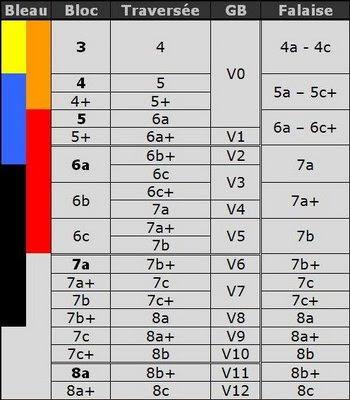 |
| Old bouldering grades conversion chart |
I suppose at that time The Wheel of life (Grampians, Australia, V16, 60 moves, Dai Koyamada FA) was still unclimbed. Basically what this table meant was that traverses should be graded like sport routes because they use more stamina and less explosive power. Problem is, later came the likes of Sharma, Hirayama, Rouhling or more recently a little midget called Adam Ondra, and they can use explosive power as a stamina basis....
So where one use to say "the hardest move of this traverse is 6a, the grade should therefore be 6c" they now say "this traverse is the hardest ever. But it cannot be as hard as the hardest route".
There is actually a good arithmetic system developed on the Australian bouldering website: that can be resumed as following:
V9 + V6 = V9,
V9 + V7 = V10,
V9 + V8 = V10,
V9 + V9 = V11,
V9 + V10 = V11,
V9 + V11 = V12,
V9 + V12 = V12
So anyway, this time I sent the French Connection II on my second attempt. So at 1 o'clock, I had nothing more to climb except a couple of projects that needed a bit of cleaning. And because I was not in the mood for gardening, I decided to drive to Doolin and try to tick off Fireworks, a cool problem opened by Gregor Florek a couple of years ago. Unfortunately every time I am around, so is the sea.
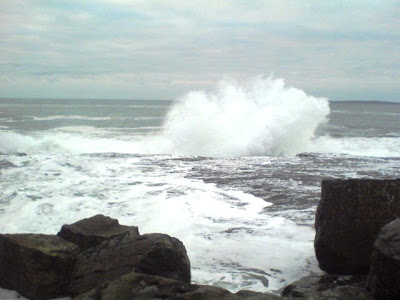
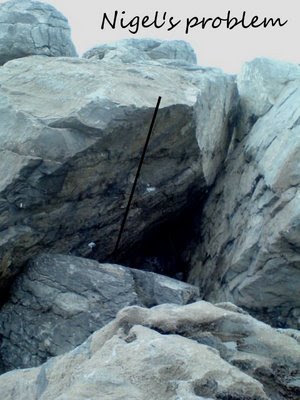
So I retreated to the base camp and instead I tried another couple of lines on my tick list. The first one is an awesome overhang that was created by the cracking of one of the boulders during the last big storm. I already had a look at it back in March when Nigel Callender was trying it, but it felt impossible. Although this time I could do most of the moves, I was nowhere near getting the last slap from the undercut (which is obviously the actual problem).
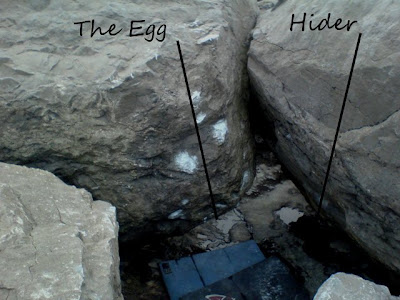
So instead of trashing myself, I moved on to my own little project: an egg sit-start that stands literally right of Hider. This little gem does not look like much, but it is probably the second hardest line I have climbed after The Nose in the White bog (OK it's still nowhere near an 8a but hey, I'll be an old daddy soon!). From a sit-start on the tiny crimp right hand, one must slap to a "pinch" hold left and move up to an obvious sloper. If you can hold that, the rest gets easier.
Well folks, this post is probably the last one about Ireland before a long time. I have been fairly busy in the last few weeks as I am finally moving to Scotland. Not that I was looking forward to it (although from judging by the work of John Watson or Dave McLeod, Scotland is definitely a great location for bouldering), but I knew this would have to happen eventually and I am just moving sooner than expected.
By the way, 13 years ago I started as a "falaisiste", but the British call it a "sports climber" AKA a "French sissy" or more simply a "wuss". I only really got sucked into bouldering when I moved to Ireland. Therefore I would like to thank those who brought me to appreciate Ireland and its bouldering potential, particularly: Kevin Cooper, Seamus Crowley and Andy Robinson; those who were (nearly) always up for an early session: Michael Nicholson, Declan Tormey and Tim Chapman, and of course the rest of the Irish bouldering crew. And no, bouldering is generally not an "extreme" sport. But neither is that trad climbing thing, "a good deal of creative frigging, resting on protection, sneaky side runner, preplaced gear, and the introduction of prepracticed ascents" as Simon Panton once described it.
Finally I cannot resist to share with you a nice picture that I have recently received. I am not allowed to say where, what or who but I can tell you one thing: there's some serious potential for exploration in Ireland!