
Mall Hill is probably my favourite venue at the moment. I first climbed in there back in 2004; At the time a good bit of the forest was still standing and the place looked very different. Dave Flanagan, Diarmuid Smith and Ped Mc Mahon had given us a tour but we were not too impressed by the walking around the place. You first need to cross a river and although this is not a problem when you wear a good pair of rubber boots, you may find these same rubber boots very inefficient when it comes to walk up hill through the wet logs and the piles of pines branches left over by the forest exploitation. The only problem that really stunned me at that time, was the excellent “
Living the dream”, in my humble opinion probably the second best Irish line in the 6 grade after Andy Robinson’s stunning “
Shadow” in Lough Dan.
However I never came back to that problem, due to various reasons: the walk in, the travel distance and off course the usual unpredictable weather. Besides I was not even sure where the bloody line was. I did come back to Mall Hill the following year with Seamus Crowley, Dec Tormey and Kev Cooper. As some more of the forest had been cleared, new boulders had

appeared: we climbed things like the “
Chigaray arête” and the “
Dublin-Beauvais” dyno. This latest boulder has a huge undercut slab and to the rear is a very round arête that looked quite attractive: this is probably the only project I kept thinking of in Mall Hill.
But after having spent most of this winter sessions in the Stonecutters Glen, I needed to come back to some well developed areas, that would involved less brushing and more climbing. So one of the latest weekends, I went back to Mall Hill with Michael Duffy and he showed me a good few lines that I did not know about: I am not going to give any names here, firstly because he did not give me any and also because I am not sure if they’re even recorded on Dave Flanagan’s guide. I came back to my round arête anyway, just to find that it was an eliminate with 3 various top outs. Without much surprise Michael sent two of them in no time, but I am foolishly still hoping that I will get the last one. He asked me to give it a French name, so I am
proposing “
Piece de Resistance”: it should suit it given the fact that it might keep one busy for a while. We also decided to check what was left of the forest, and there it was again: although it was too wet to climb it at that time, “
Living the dream” was waiting silently hidden in the forest, 20m away from the path. I had forgotten how good that line looked like but I was psyched straight away.
I missed a good opportunity two weeks ago thanks to the good old Irish mist so this weekend I did not leave anything to chance: I came prepared with 3 mats and my old reliable mate Michael Nicholson as a spotter. We warmed up on what looked like an uncleaned line: after some serious brushing Mikey sent what he wanted to name “
Kate Moss”. After having checked the guide, it seems that this line had already been climbed as it matches the description of “
the small matter of up”, something which we find really hard to believe given the amount of cleaning that was required prior to any possible attempt. We then moved towards the goal of the day, and although I must admit I firstly felt nervous, I sent “
Living the dream” in a couple of tries. So our attention turne

d to 2 other projects on the same boulder. The first one is “
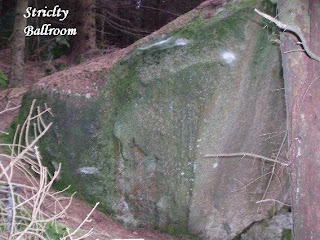
Strictly Ballroom”, a hard sit-start to some very slopey holds that link onto the traverse of the top of the boulder. This remains a project. However the other one gave up after a good few attempts. “
Coup d’etat” is a hard deadpoint that can result in a high, funny but very safe fall if missed. This is probably what I like most about all these lines: unlike Glendalough, the landings are generally very safe.
Altogether Mall Hill is a beautiful place loaded with problems and projects. And the forest part is very enjoyable on a dry day, so I strongly recommend it to anyone who has not been there yet. And do not wait because I would not be surprised if next year the whole forest was cleared. I am currently putting some videos together which should be shortly be available here.
 I hope everyone enjoyed the good sunshine over the bank holiday. I spent the Monday afternoon in a crowded Portrane with Chris Rooney and Michael Duffy. Michael cleaned the upper part of the Arch, and gave it a good few attempts: he has worked out most of the moves to the high brown stone jug. What would make it an ultimate line would be a top out to the left, although this would require some good spotting and a few mats. Definitly one of the best lines in Ireland.


 Park at the same carpark than Lough Bray, two kilometres south of Glencree on the military road beside the small quarry. Go up to the top of the small quarry and walk through the bog toward the Sugarloaf. Lough Bray should be in your back and Glencree on your left. After 20mn you will reach the Stonecutters Glen. The first main boulders you should come across are the egg and the split boulder.
 The Egg is the first big boulder you should come across. It has a very recognisable roundish blank slab (project) and a nice problem on its north side (right side on picture) involving a tricky top out on a round top: The egg. On the smaller boulder below is good sit-start deapoint that takes a few tries to adjust: Bloody clawmarks.
 Upper on the valley stand two nice boulders. There’s been blood is the excellent arete shown on the
  Brutal overhanging arête. Definitly the hardest line in the Stonecutters Glen. Rif Raf is the hard deadpoint from a crimpy rail on the right hand side.
  The Big triangle slab at the top end of the valley is definitly worth a visit. The left hand side is Rock it : From the big bottom step rock over the arete to reach a good break higher and top out.
 Here's a little bit of info on Albarracin because some people asked me about it recently (namely Al, Chris and Michael), so that's for you guys.

