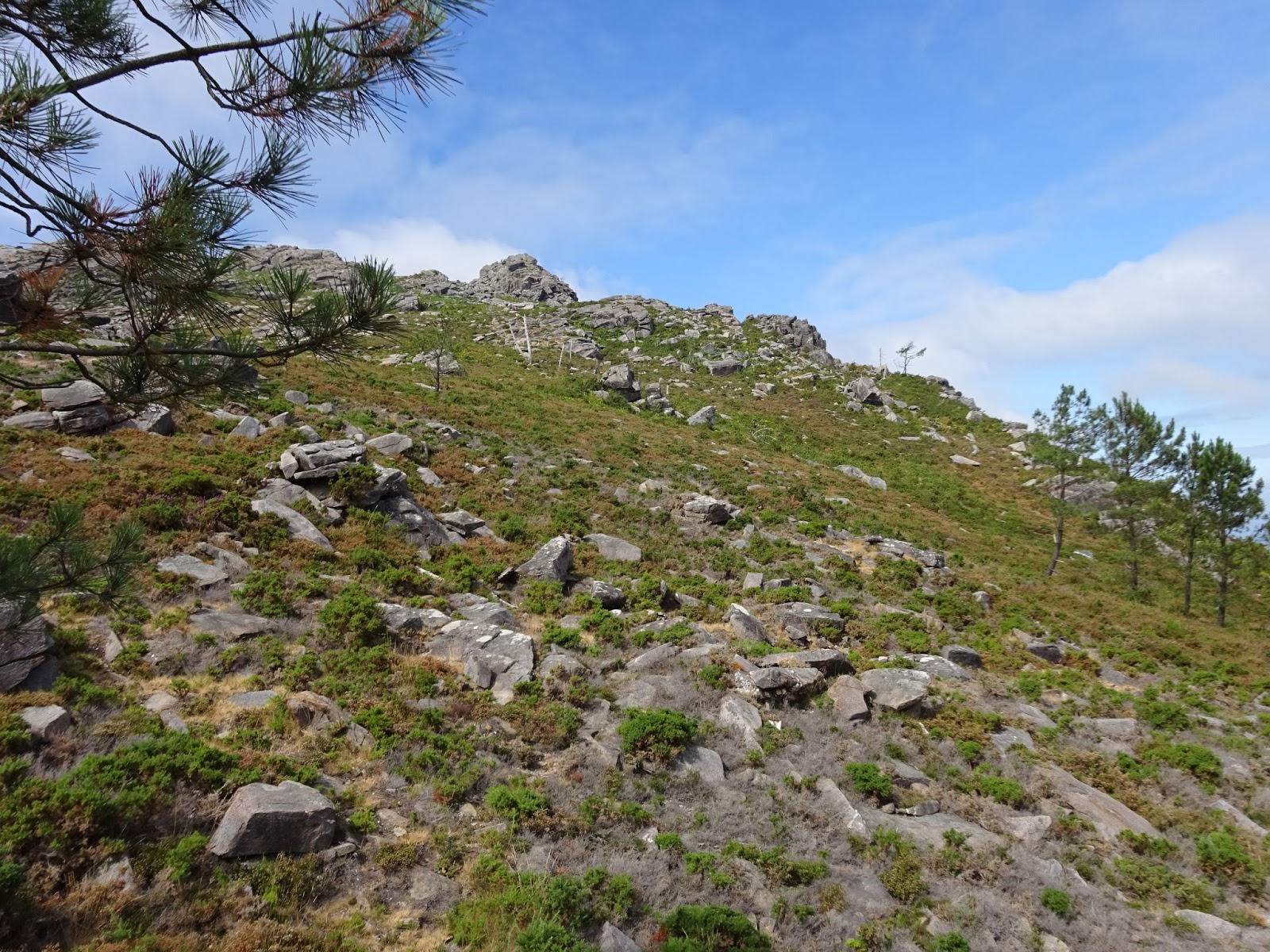
The last problem is called "Home de ferro" (Iron man). It's a classic 6c in Cabo Prior near Ferrol. The granit is rough but the location is really beautiful. For more info, get the topo for all the bouldering spots in the north of Galicia:
Boulder en Galicia, Guía Zona Norte,(in Spanish), By Alejandro López Sánchez, 2013, Published in A Coruña, Galiza (Spain) by Campo IV Available at: Terra Deporte Aventura, Pi y Margall Street, no 53, Vigo 36202 (Tfno: 986 439 431) and also at www.libreriadesnivel.com/libros/boulder-en-galicia/9788493990718/
Earlier this year, I sent my latest project at the local seaside venue that I discovered last year.
It's called "ìosal". It means "low" in Scottish Gaelic, because it is a low traverse and well... you can't climb it when the tide is high.
I haven't got a clue about the grade. It felt like the hardest climb I've ever sent, but then, every time I send a project, it feels like that.
Still, this one is 5 or 6 moves long - the end part being much easier, so it's a solid 7b problem, probably harder.
There are a few other cool problems around but I won't give more details here - there should be plenty within the next edition of John Watson's Bouldering in Scotland guidebook.
Leaba Na hAon Bho in Oughtdarra is an inland crag a little further up the road pass Ballyryan crags in the Burren (park at the Crumlin stone sign).
It's a bouldering option when Doolin boulders are soaked by sea spray - because the same sea wind that sprays the boulders in Doolin dries those further up inland.
Tayto Boulder - South Face
The cracks and features of this boulder were filed with empty crisp bags.
This may be part of a local cult but given the proximity to the crags, it is possible that this dirty practice belongs to various social groups including hill walkers and climbers.
I sincerely hope I'm wrong.
I've removed many of these bags but if you find some more, please take them home.
The Burren is no one's backyard.
1. Tayto, 5. Sit-start in the groove crack and go straight up to top out.
2. Mister Tayto, 6a. Same start but traverse the diagonal crack to reach holds beyond the round prow then top out.
3. The man inside the jacket, 6c. Traverse from far left (sit-start on big vertical crack) and link into 'Mister Tayto'.
The reach (6a?)
The cool moves of this problem are actually the start to a trad route called The Reach (E1 6a).
Start to the left of the slab with both hands on a sharp pocket and reach far right for an obvious crack. After this, it's either an easy highball or a jump off back to the bouldering mat.
Arán Is Im
1. Arán, 5. Sit-start on the bottom right of the prow and climb it straight up on sharp holds. Top out.
2. Im, 6a. Stand start on the left side (north facing) and climb up using a system of cracks. Top out.
3. Arán is im , 7a. Hard link. Sit-start on Arán but cross leftwards using a slopey crimp (right hand) on the arête to reach the cracks to the left. Then finish up as for Im.
Everyone speaks English these days, right? So will the French understand
the following climbing terms?
Arete ✓
An “arête”
is a “ridge” in French. And in English too, the
word is written with that little funny accent that they call a circumflex – according to Oxford dictionary anyway.
Beta ✗
Although
more terms get into French thanks to the supremacy of American English, this
term supposedly coined by Texan climber Jack Mileski in 1981 is unlikely to
replace its French equivalent, méthode.
Interestingly, method is probably a rare example of jargon that was first used
by boulderers. In the context of climbing, it was first used by the Bleausards.
Crux ✓
This is the
Latin word for “cross”, which for Christians, is synonymous of “crucifixion”. The
French share with the Italians the belief that their language is more Latin
than the Pope’s. So while French climbers will certainly know and use this
term, they will firmly believe it is a French word. And wrongly so: the word is
not in their dictionary and was probably borrowed to English. Incidentally, to tick a problem is faire une croix in French (to make a cross mark) and a tick list is a carnet de croix (cross mark book).
Deadpoint ✗
Supposedly
first used by John Gill in 1969, this very useful word started
to infiltrate the French climbing jargon only recently. It would be a great addition
to French climbing lingo as it has no equivalent.
Dyno ✓
Short
English words tend to be perceived as cool in French, especially if they look
like something familiar, which is the case of this shortening of mouvement dynamique. Having said that,
the French did not wait for John Gill to practice dynos – and they could have waited a long time since
he’s never travelled to Font. Before the Internet was
invented, dynos were called jetés
(throws).
FA✓
Thanks to the popularity of web platforms promoting the competitive way of life, everyone is aware of the importance of first ascents. Yet it is
unlikely that the English term will replace the French term. Indeed, FA are
called openings (ouvertures) in
French, because after all, FAs are about sharing.
Figure-4 ✗
The name of
this climbing move was supposedly coined in 1982 by British climber John Arran.
But the French don’t know who John Arran was (er… is?). They do know Tony Yaniro
however, who popularised this move – so in French, this is called Le Yaniro.
Flash ✓
French speaking climbers and
boulderers climb à vue (on sight), après travail (red point) or, like in
English, flash. All three expressions
are used as adverbs, not as verbs, duh.
Font ✗
This popular nickname in not used
by the French. As far as the Bleausards are concerned, Fontainebleau has always
been called Bleau – pronounced a bit
like “blow”. Why would you change the name of your pond? Plus, everyone knows that a font is a type of printing characters, right?
Gaston✗
This was a popular baby name in the French city of Marseilles in the 1920s. So it was the name that Mr and Mss Rebuffat chose for
their son when he was born. He later climbed lots of mountains including the
Grandes Jorasses and the Annapurna. Despite this fame, the French call the gaston move a shoulder move (épaule). Shameful really.
Highball ✓
According to Sherman, the term “highball” derives
from the similarity between a highball climb and a highball cocktail glass.
Both should be enjoyed with moderation. The French know what moderation is, but they
usually think highballs have something to do with balls. And getting high.
Mantle ✗
French climbers don’t climb on
their mantelshelf, they prefer to “re-establish” themselves, hence the climbing
term réta (for rétablissement). Réta Authenac,
for instance, is a famous 6b mantel of the Cuvier sector in Font, first climbed
by Charles Authenac, in the 1930s, in his hard walking boots. He originally
graded it 5+ but it must have taken him more than one session.
Rose move ✗
The English
term derives from the world known French sports route La Rose et le Vampire, at
Buoux. The French may feel honoured by this English choice of words, but they
prefer to use the word derviche tourneur,
or derviche for short, which in Farsi
language refers to someone treading a Sufi Muslim ascetic path in poverty and
austerity. That’s because derviches from the Mevlevi Order perfom a famous
whirling dance, hence the name given to this move.
V-scale ✗
John Sherman was born in 1959. The First Fontainebleau guidebook
was published in 1945. Do your maths and you’ll understand why Font grades take
precedence.
Voilà!
Réta Authenac, in bas Cuvier, a famous mantle from the 1930s
Roots cannot be authentic without legends, heroes and Gods, figures who newcomers can look up to.
As early as the 1940s, kids were riding boards on each side of the Atlantic.
This is a fact.
There are photographs and written reports - US army auxiliary Betty Magnuson, for instance, reported in her letters having seen children in 1944 Parisian Montmartre riding boards with roller skate wheels (info sourced on Wikipedia).
That's what kids used to do. They'd screw the wheels of roller skates to a wood board, like this:
Actually, four-wheeled roller skates were patented in 1863, so it is likely that kids started to build skateboards even at the time of the rinkomania.
But such activity is not perceived as ‘proper’ skateboarding by today's skateboarding community because, authenticists argue, these kids were ‘children'.
They were not skateboarding for the sake of it. They were ‘messing’. They were ‘just’ playing. Authenticists claim that skateboarding ‘as we know it’ or‘as an end in itself’, was born when adult Californian surfers decided to invade the urban realm while sea waves were flat. In the authenticist discourse, the people who give the legitimate birth to the practice are often called ‘pioneers’. They’re usually described as the ‘first’ to have done something.
Here are the actual words of an authenticist, John Severson, publisher of The Quarterly Skateboarder, in his first editorial in 1964:
Today's skateboarders are founders in this sport—they're pioneers—they are the first. There is no history in Skateboarding—it's being made now—by you.
The authenticity of skateboarding had been forged in a couple of sentences. The coronation of 1964’s skateboarders as ‘founders of the sport’ forged the myth and initiated a cult. Even more striking is the denial of any pre-existing skateboarding facts – ‘there is no history in Skateboarding’ - which means that any previous recorded skateboarding activity, such as that of kids having fun in the streets 20 years earlier, is considered as pre-historic and therefore illegitimate.
By writing up history, the authenticist forges history, never mind the facts.
To conclude, here's an inspiring video archive from the 1930s (maybe?), featured on Gizmo!, a documentary by Howard Smith, released in 1977. Among the daredevils could be John Ciampa, the ‘Human fly’ from Brooklyn, and the German stuntman Arnim Dahl. Does this qualify as authentic buildering? Or as parkour, perhaps? Gosh, no, wait... They're not doing it as an end in itself, right? Well, never mind, let's call it ‘fun’.
While civilized celebrations were going on at home at the Edinburgh festival, I was enjoying myself, abroad, at a primitive fiesta.
Stones and rocks were to primitive people what cats and dogs are to us. I was bound to find boulders.
Unga Unga, 6b+/7a
The event was held in a clearing among the woods. The woods were full of big stones, many of them holding prehistoric marks, which gives the locals an excuse to get stoned:
They also use babies. They throw them at each other or use them as cushions. Some females even use them as fashion accessory:
The local granit is as rough as its primitive masters, but I survived anyway. Here's the climbing info:
Reta Cromañón, de pies, 6a
Matapiollos, sentado, 6b
3. Lance, sentado, 6c
4. Saida proyecto
5. Proyecto eliminante, fenda 6. Unga, de pies, 6b+ 7. Unga Unga, sentado, 7a 8. Variante Unga, de pies, 6b+ 9. Piel de troll, 6b+
Otro proyecto a cepillar
Our local guide, Bob the boulder:
Can you fix me?
Hai moitas pedras entre A Gándara e As Regadas no campo de festas prehistoricas do Parque da Penacova:
Usted esta aquí
The traditional gogomap locator:
And finally, the flyer of the Festa da Prehistoria:
Topo: Boulder en Galicia, Guía Zona Norte,(in Spanish), By Alejandro López Sánchez, 2013, Published in A Coruña, Galiza (Spain) by Campo IV Available at: Terra Deporte Aventura, Pi y Margall Street, no 53, Vigo 36202 (Tfno: 986 439 431) and also at www.libreriadesnivel.com/libros/boulder-en-galicia/9788493990718/
The Second version of the Pedra Rubia guidebook has been published in June 2013. The first version was published the previous year (June 2012) but did not include a section about Portocelo.
If you’ve followed my blog, you might remember that I had climbed a few lines in Portocelo back in 2010.
At the time, I had looked for info everywhere, but had not found any either online or on paper. The only thing I knew was that it wasn’t a proper discovery. On a Galician forum, a guy called Luis Vigo had told me Portocelo boulders had been a climbing spot for the last 15 years and had even seen the first Galician bouldering comp in 1998.
So in an effort to share what I knew, I had post up some info online, via my own blog, YouTube, the web platform UKClimbing, Facebook and the likes.
Five years later, I find that some of ‘my’ problems (for more on ownership, see previous blog post) have been recorded in a guide book under different names and displaying different grades.
My first reaction was that of a six year old. I thought it was not fair. But after second thoughts, I realized that the people who had published the guidebook could hardly know about my FAs.
After all, my blog is written in English and only a handful of people reads it (thanks for your patience if you’re one of them), so I probably don’t rank very high in Google relevance charts.
Besides, 'my first ascents' were probably not proper FA anyway.
Nevertheless, it’s very interesting to compare the grades:
2010
César Alvarez, 2013
Difference of grades
El Zambulidor
6c
El Dragón
?
n/a
El Gigante verde
6a
Espantallo
6b+
+3
Super Tanker
7a+
Super Tanker
7a+
0
El pesa’o
6a
O Electronico
6b
+2
Techo izquierda
5+
Corner Ongui
6b
+3
La fisura del techo de Portocelo
6a
O Fendeteito
6c
+4
Techo derecha
6a
Corner Etorri
6b+
+3
Interestingly, some of the 2013 names are in Galician (the local language) rather than Spanish. While I can speak Spanish, my understanding of Galician is limited and I could have hardly found many problem names, so I’m actually quite glad these problems have proper local names.
Although some other lines also show striking similarity, the lines shown in the table above are all the exact same. This observation points towards the existence of 'natural' lines, i.e. problems that are not just the result of one person's imagination, but that seem obvious to people who have not been in contact at all. Do 'true' lines exist? I believe so.
Yet the grade difference is substantial. In all cases but one, the difference varies from 2 to 4 grades, the maximum difference being from 6a to 6c. Either I was sandbagging, or inflation is rampant in the 6 grade sector.
I doubt that I was completely off the mark though. I have climbed a lot of boulder problems in the 6 grade, on granite, in different places and countries including Ireland, Scotland, France, Spain, and in various conditions, from bone dry windy days to miserable drizzly days, and from -5°C to +30°C. So while I could be wrong with 5s and 7s grades, I think I’m fairly accurate when it comes to 6s.
Another interesting fact - for social media addicts anyway - is that the only boulder problem that has the same name and the same grade (Super Tanker, 7a+) is also the only problem that I’ve named and graded on YouTube for this area, which would imply that YouTube is more visible that the other social media I used - but we all know that watching vids is easier than reading info, right?
In any case, I thought this really put in perspective the power of the Internet - It’s not sufficient to share info online, people have to be able to find it easily!
Also, we should not underestimate the power of languages. Not everyone speaks English. Or want to. The same goes for Spanish. Some people speak and use Galician for bouldering, which means this minority language is well and alive.